
Securing back-to-back Premier 15s with Saracens in 2017/18 and 18/19 is still the moment that stands above everything else in my career.
Being on the pitch when the final whistle went, turning around and being able to hug some of my best mates like Zoe Harrison and Hannah Botterman, that is difficult to beat.
You spend so much time together, you train together, you go through difficult periods together and then eventually you get that reward.
For me, that is what rugby has always been about.
Important
Saracens became one of the most important clubs in my life and some of my favourite years in the game were spent there.
One of the biggest reasons for their success has been continuity.
Alex Austerberry has been enormously important to that – he has been one of the key ingredients behind why Saracens have been so successful over such a long period.
I have played in environments where coaches and players constantly change and you see how fractured a squad can become.
At Saracens, you have players staying for years.
You have people reaching 100, 150 or 200 appearances while still relatively young.
Alex is incredibly honest. People might sometimes look at him and think he is a bit of a grumpy old man, but he knows exactly what he wants from his team and he has learned how to communicate that to different people.
That consistency creates trust.
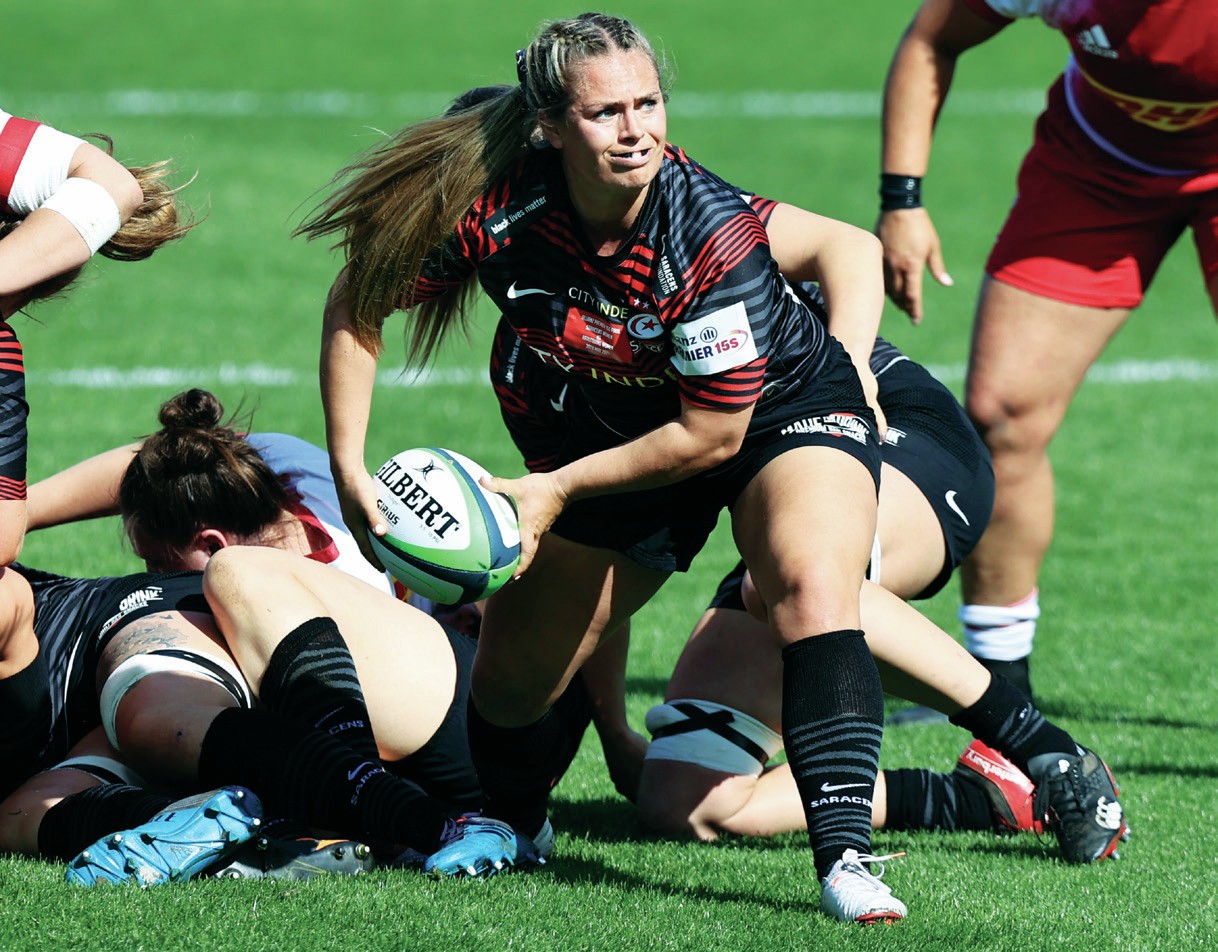
In action: Emma Swords playing for Saracens in the 2021 Premier XVs final.Favourite season
My favourite season there was around the Covid period.
We had a brilliant group, with some of the first Canadians coming over such as Sophie de Goede, Alysha Corrigan and Emma Taylor.
Zoe and Hannah were there and we had such a good time together.
We eventually lost the final to Harlequins that year, but despite that, it remains one of my favourite seasons because of the people and the environment we had.
My rugby journey itself started almost by accident.
I was about 13 at Winston Churchill School in Woking and I got kicked out of girls’ PE because I wasn’t particularly interested in the contemporary dance lessons.
My teacher sent me across to boys’ PE instead and they happened to be playing rugby.
I absolutely loved it. From there the school started a girls’ rugby team and quite a few of us went on to play representative rugby.
Best mates
I joined London Irish and that was where I met Sarah Bern and Alex Matthews.
Sarah and I have been best mates ever since. Back then she was playing at inside centre with me at fly-half, which feels ridiculous now when you look at the player she became.
She moved from 12 to No.8 and then eventually England told her that if she wanted to progress internationally, she needed to become a prop.
She hated the idea. I remember her crying and refusing because she did not want to move into the front row.
Eventually she gave in and it turned out England probably knew what they were talking about.
After London Irish we moved to Esher and then, at 17, I joined Saracens.
Lion
I was very fortunate to have people such as Maggie Alphonsi around me early on.
Maggie was my talent development officer before I even joined Saracens and one thing she was brilliant at was making young players believe in themselves.
I remember her meeting me while I was at college in one of the most rundown pubs in Woking.
We sat there with a soda and lime and went through my whole development plan.
She was already one of the biggest names in the women’s game, but there was absolutely no ego.
Her basic message was that even if you didn’t always feel like a lion, you had to carry yourself like one.
That stayed with me. Training against her at 17 was considerably less enjoyable.
Huge part
Harlequins then became another huge part of my career.
My first move there came partly because once my dad stopped being my taxi service, travelling from Guildford to north London several nights a week became much more difficult.
Gary Street was involved and I met people such as Jess Breach, who became one of my closest friends.
Covid interrupted that first spell and I went back to Saracens before returning to Quins again.
I would eventually have three separate spells there. That probably tells you how much I loved the club.
There were ups and downs, changes of coaches and moments when things didn’t quite work, but I always had a real connection with the people.
Good people
Between my second and third spells at Quins, I joined Ealing Trailfinders for their first season in the PWR.
That was another year I absolutely loved.
Nobody really knew what to expect from us. Everything was new and Giselle Mather was very good at creating a deeply connected group quickly.
There were people arriving from completely different rugby backgrounds, but everybody worked incredibly hard.
What stands out to me about Ealing even now is how many genuinely good people are there.
There is a warmth to that group which made the first season particularly enjoyable.
International rugby
Eventually Ross Chisholm asked if I wanted to return to Harlequins and I spent another two seasons there.
My contract has now finished as the club goes into another rebuilding phase with a younger group of players, so I am at another interesting point in my life.
One of the more complicated parts of my career came through international rugby.
The year before I played for Ireland, I had spent some time in the Wales set-up because I qualify through one of my grandparents.
There were some very good people there, but I didn’t feel I was doing it for the right reasons and I stepped away.
When Ireland approached me the following year, I was really unsure whether I wanted to go back into international rugby.
One of the biggest considerations was losing my English-qualified player status, but my club encouraged me to take the opportunity.
Debut
I made my Ireland debut against France in the 2023 Six Nations and got around 25 or 30 minutes.
On paper, it was something I should have dreamed about.
But if I am being completely open, I don’t think going into that environment was the right decision for me at that point in my life.
There were some brilliant people there, but the team was going through a difficult period and I ultimately left camp a week early.
The consequences lasted much longer than that one Six Nations.
Once I had played for Ireland, I was no longer EQP and that affected selection at club level.
There were times when coaches were completely honest with me and said I had trained well enough to play, but they needed to hit their EQP numbers.
Biggest lesson
Last season at Harlequins, I barely featured in the first half of the campaign because of that before getting much more game time later in the year.
That has probably been one of the biggest lessons of my career.
International recognition can look like the ultimate validation from the outside, but you have to make decisions for the right reasons.
A rugby career is short and something that appears to be an incredible opportunity can have consequences you do not fully appreciate at the time.
I hope with age I will look back on that Ireland cap with greater pride because it is still something very few people achieve.
Business
For now, a huge amount of my energy is going into Below the Shoulder, the business I started alongside Sarah Bern, Zoe Harrison and Jess Breach.
The idea came during the 2025 World Cup because we looked at some of the merchandise around the women’s game and felt it didn’t really represent us.
We thought: why don’t we create something ourselves?
It started with slogan T-shirts and a photo shoot but quickly became much more about events and creating spaces around women’s rugby.
We threw a massive World Cup after-party which ended up with players from all over the tournament turning up.
Ever since, whenever there is a major women’s game, we get messages asking whether we are hosting something afterwards.
That showed us there is a genuine space for it.
Women’s rugby has grown enormously on the pitch, but there are still areas around the matchday experience, merchandise and events where we can put our own identity on things.
I have had a few rugby offers and I have not completely decided what comes next.
For now, I want to give Below the Shoulder a real opportunity to grow while keeping an open mind about playing.
I do not want to completely walk away from a sport that has given me so much.
READ MORE: My Life in Rugby: Monty Bradbury – Playing for England’s U20s made me proud