
MY LIFEIN RUGBY
THE FORMER SCOTLAND, GOLDEN LIONS, GLASGOW, LONDON IRISH,LEEDS AND EDINBURGH BACK ROW/WING
Ialways found I played at my best when I didn’t have the sense of pressure that often comes with professional sport –a pressure to be on top of everything, constantly trying to prove yourself for coaches. Many of the coaches I played for were trying to get to grips with the professional game themselves.
On the flip side, coaches like Eugene Eloff – one of South Africa’s most successful age grade coaches – Richie Dixon and Rob Moffat, in my early days at Glasgow, and Gary Gold during my time at London Irish, knew how to get the best out of me. Yes, they had structures and game plans, but they knew their players and gave me freedom to just play.
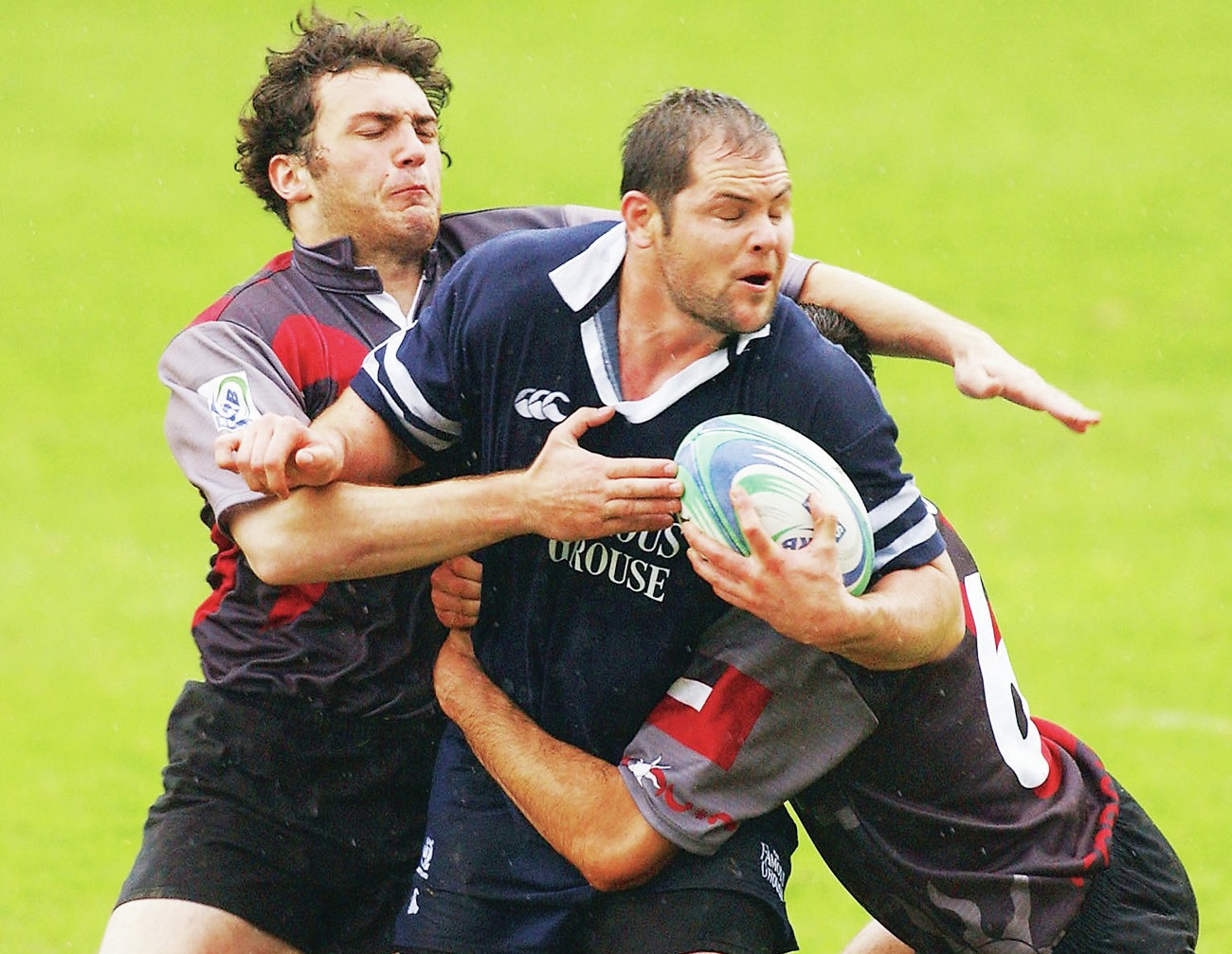
With my height, weight and pace, I was billed as McLomu. To be compared to one of rugby’s most iconic superstars after one Test was just ridiculous. If you look at players like Tim Visser and Duhan van der Merwe, they’re the same size as me, but they are out-and-out wingers. Some days I would play games starting in the back row and ending it on the wing and vice versa. In retrospect it probably did impact on me in terms of my identity as a player.
I think I played OK in my two Test caps for Scotland on the wing and I did well for Glasgow there but No.8 is where I really loved playing and produced my best rugby. It gave me the freedom to run with the backs and to get involved in the hustle and bustle of the forwards, the best of both worlds.
As a result of the frequent changing of positions, it made it more difficult to get consistency in performances. When you’re in the back row, it’s all about power and endurance, you rarely get up to sprinting speed over distance and you have a different type of weights training, so there was a physical impact too. I ended up with torn hamstrings, and one season I struggled really badly with a hernia injury. That cost me seven months and a possible place in the 2003 World Cup squad.
Injuries are part of the game and I had many, even some random ones such as a waking up blind in one eye. It turned out I had a detached retina, most likely caused by being eye gouged or taking a punch too many. I also had a suspected mini stroke, supposedly caused by scar tissue in my neck from previous injuries, that caused severe vertigo. I really learnt to appreciate the medical staff that looked after us.
Every rugby player has an embarrassing moment. Mine was during my days as a Scotland international. I scored with my very first touch in international rugby as a replacement on the wing against Tonga. That was an indescribable feeling and I can remember every second of it! The following week I got selected to start against Argentina.
The team announcement, especially your first start is traditionally a big deal, an absolute privilege to receive the jersey and to honour those that have played in it before you. The trouble was I didn’t hear my name being read out as I’d fallen asleep in my hotel room and was late for the team meeting. I have recurring nightmares about that moment, even to this day.
Leaving South Africa with nothing but a green suitcase (which I still have) and every penny I owned (about £400), coming to Scotland was the right thing to do at the time, based on what I knew and the advice I had been given. I had watched Braveheart about 20 times ‘in preparation’! A couple of times I did wonder if it was the right move because I’d gone from playing in front of a full Ellis Park Stadium for the Golden Lions in the Currie Cup to Glasgow and playing in front of a couple of thousand people and training in sleet, snow and freezing cold weather.
“Dreams of being an Olympic long jumper were dashed when I fractured my back”
Mel Gibson has a lot to answer for! I certainly didn’t expect to be in the Scotland national squad so early on: I arrived in November 1999 and I went on the 2000 tour to New Zealand the following summer. I enjoyed every minute of that tour and made friends I still have today.
My focus had turned to rugby after my dreams of becoming an Olympic long jumper were dashed when I fractured vertebrae in my lower back. Rugby became an obsession rather than a passion after that. I had already lost one dream; I was going to make another no matter what.
Unfortunately, inconsistency was a recurring theme throughout my career. I’d play well, be really enthusiastic and feel worthy, only for things to fizzle out. At the time it was easy to blame coaches, the selection process or bad training programmes, and some of the time it was those things. But after I retired, I really reflected on my playing career and asked the question, ‘what’s the common denominator? and the answer was obvious, ‘Oh yes, you know what, it’s me’.
I finished playing after a couple of seasons at Edinburgh. The first season – as a back row – went really well but then Andy Robinson came in as coach and I was moved back to the wing and my body wasn’t ready for it. I was much heavier and bulkier than before and it wasn’t long before the injuries hit. A pulled calf was followed by a hamstring injury. I was also struggling with a persistent knee injury and had two operations to remove cartilage. The surgeon said, ‘there’s not much left, you’re best calling it a day’. I managed to go to the Rugby Sevens World Cup in Dubai that season but it was all too much for my knee.
Without rugby giving me a purpose, I really struggled mentally for a couple of years after I finished playing. But with the support of my wonderful wife who I met in Glasgow, I got through that tricky time. One thing I learnt and absolutely adore about rugby, is that you become part of a worldwide community. You can go anywhere in the world, walk into any place and find someone to have a chinwag about rugby to. To see that community rally around Tom Smith and Doddie Weir is heart-warming.
The connections I made during my playing days helped me to carve out my next career. Hamish Taylor, a marketing and innovation expert, took me under his wing and taught me the ropes on consulting and Andy Lothian, owner of Insights, put me through their accreditation programme. I’m now a consultant in change management, performance coaching and people engagement and I’m much happier in who I am than I ever was a player.