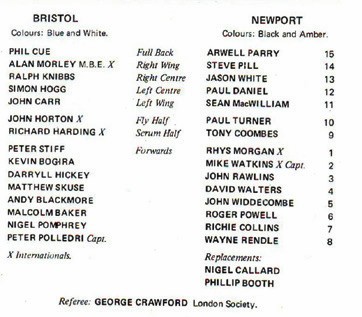
George Crawford remains the only referee to make the ultimate protest over on-field violence between old Anglo-Welsh foes. Twenty minutes into Bristol‘s scrap against Newport on September 14, 1985, he walked off, never to return.
At a time when football was being disfigured by hooliganism on the terraces, Crawford arrived on that warm autumn Saturday in eager anticipation of ‘a nice game’. Instead he found himself surrounded by alarming outbreaks of the old joke about rugby union solving crowd trouble by putting all their hooligans on the pitch.
More than 40 years on, it still beggars belief that the Rugby Football Union made the scandalous decision to put one person in the dock: not a single member of either side guilty of serial offences, not the clubs but the referee whom they had driven to the earliest of early baths; a Metropolitan Police officer newly promoted to the rank of Chief Superindendent.
Instead of coming down like the proverbial ton of bricks on those who broke the law, the RFU heaped every single one upon the referee. Refusing to back their man would have been bad enough, punishing him appeared to many as a reflection of a see-no-evil culture endemic amongst the game’s Establishment.
The four home Unions had still to be jolted out of their aversion to any light being shone on the game’s unspoken problem of gratuitous violence. Such matters were still being swept under the carpet 40 years ago and any referee with the courage to take a controversial stand ran the risk of being swept under the same carpet.
Crawford, from Coleraine in Northern Ireland, had seen that for himself over a playing career which took him from propping against Ballymena and the Lion-hearted Syd Millar to Met Police and London Irish. The referee who had the courage to blow the whistle on what he saw that day at Bristol had been struck by the fates of three international colleagues: Ireland’s Kevin Kelleher, the Scot Norman Sansom and England‘s Roger Quittenton.
Each had been at the centre of contentious incidents; Kelleher for sending All Black Colin Meads off at Murrayfield in 1967, Sansom for the only double dismissal in Test history (Geoff Wheel and Willie Duggan, Wales-Ireland 1975) and Quittenton for the fateful penalty which got NZ off the hook in Cardiff three years later.
“Those three referees were really treated very badly. Norman Sansom was the best referee I ever saw and yet
they gave him the heave-ho. Instead of being highly valued and lauded for their ability and readiness to enforce the law, their careers were allowed to fade away.
“I knew mine was in doubt when the RFU called me to Twickenham for what was supposed to be a bit of a chat. Instead I found myself facing a disciplinary board. I thought: ‘This can’t be right.’ You had players dressed in the colours of famous clubs going about their thuggish business. If that had happened on a football field, there would have been an inquiry.
“Instead of being thanked for my action, I was castigated by those at the RFU responsible for the well-being of the game. The Bristol-Newport match had been televised by HTV.
“I said to the disciplinary panel: ‘Let me see the video. I can then identify those guilty of violent conduct. I will name names, you can deal with them and show the game at large that we’re not going to tolerate such behaviour.’
“If that had taken place outside the Rose & Crown, there would have been a few arrests”
“They were not the least bit interested. It was too hot to handle. Identifying foul play by video is exactly what happens now and that’s why the game is so much cleaner than it used to be. The RFU should have been leading the way 40 years ago.”
The day after the tribunal the RFU issued a statement via the Press Assocation with their verdict: a severe reprimand which they claimed Crawford had accepted. It coincided with the besieged referee finding a powerful ally in the late Edward Grayson, a barrister renowned as the father of sports law who sensed a gross injustice.
“Edward phoned to ask whether I had accepted this severe reprimand. I told him this was the first I had heard of it and that I most definitely did not accept it. Edward was marvellous. He wrote to the RFU saying if they did not withdraw the severe reprimand we would take the matter to court. I was up for that. The RFU then withdrew the reprimand. I resigned there and then.”
Even now at 83 and still going strong, Crawford’s memories of the Memorial Ground and that match never fade away. “It’s emblazoned in my mind. I thought: ‘Two famous old clubs and a full-house. This is going to be a nice game.’ Soon it became all too clear that it was going to be a punch-up. I warned the captains that it had to stop and that if it didn’t I wasn’t going to waste any more of my time.

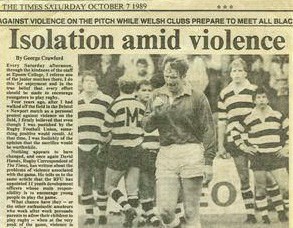
They didn’t listen. If what had happened in that match had taken place outside the Rose & Crown on a Saturday night, there would have been a few arrests.
“As a policeman, and a senior officer at that, I was well aware of my responsibility, that if I witnessed a criminal offence like a serious assault I am going to end up arresting someone. I would have had to make an arrest.”
Like frog marching the suspect or suspects off the pitch into police custody? “Exactly that. I decided I did not want to put myself in that position. I had gone to Bristol that day as a rugby referee. What I saw called for a boxing referee. I had to make a stand. When I was in the changing room an old friend came in and pleaded with me to go back out. I told him: ‘No. I’m going home.’ And I drove back to London.”
Crawford’s 30-year career with the Met, decorated by the award of the Queen’s Police medal, ended in 1992. He spent the next 10 years with Crystal Palace FC as head of security at
Selhurst Park, then ventured into local politics as an independent member of Epsom & Ewell Borough Council.
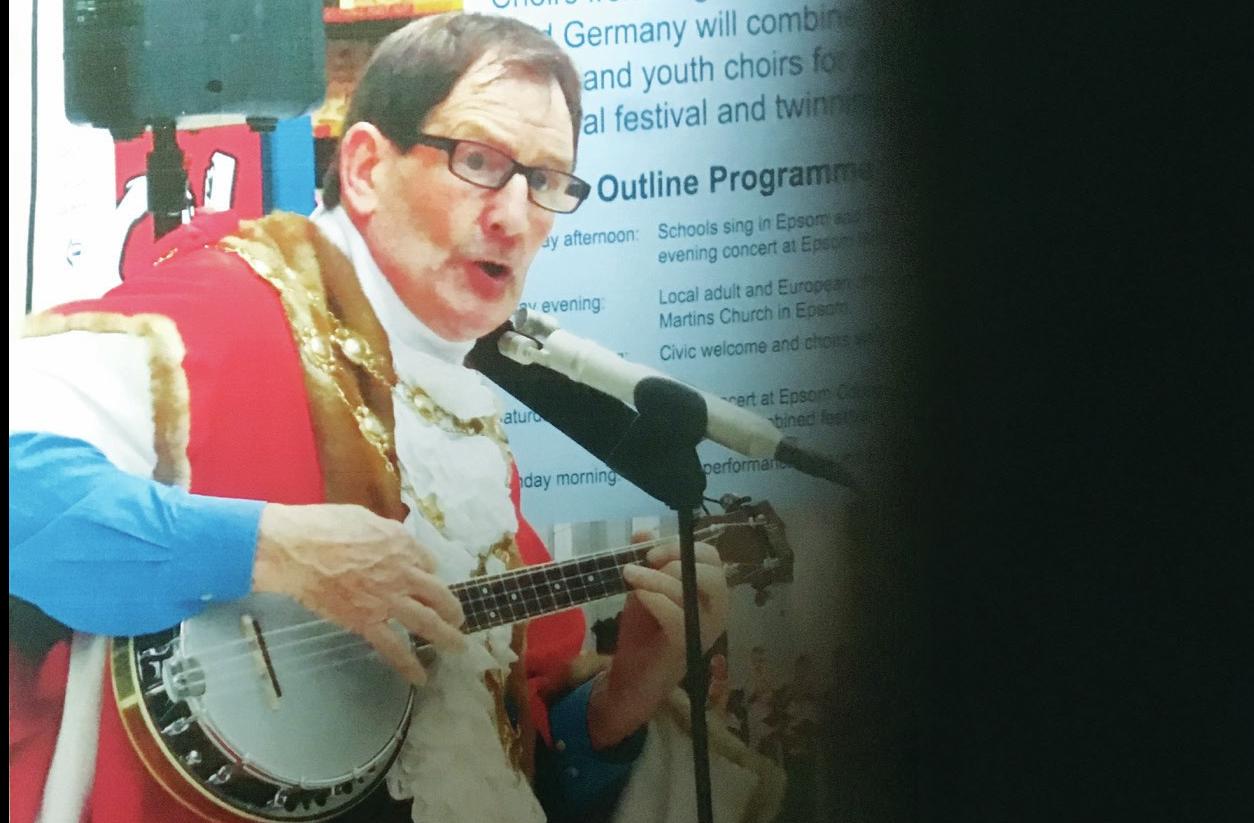
George’s mayoralty in 2016 is still fondly remembered, more for his George Formby impressions on the ukulele in aid of charity than for the referee whose protest cajoled rugby into cleaning up its act.


Latest News
SA could withdraw sides from Europe

Latest News
Commanding Charlie has got ‘another level’
Latest News
Ritchie moving on



The best betting sites