
Ten thousand hours seems a suspiciously convenient round number, but there are plenty of big brains who see it as the key to the universe.
Looking for mastery in your chosen field, from playing the saxophone to playing scrum-half?
All you need is a strict regime of hard yakka: nine to five, seven days a week, 52 weeks a year. If you start now, you’ll be done and dusted some time in 2029.
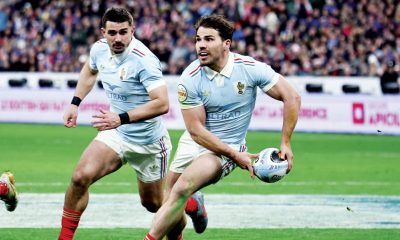
What you won’t be, of course, is John Coltrane or Antoine Dupont. You can practise to your heart’s content and still be bamboozled by genius.
That’s the thing with the very best of the very best: they operate at a level beyond understanding, let alone emulation.
But fear not: in rugby union, there are easier ways to climb the mountainside and head towards the summit.
Top tip number one: find yourself a father who was good enough to have played the game at Test level.
Tip number two: make sure he has access to sufficient funds – or, failing that, wields enough influence – to send you to a swanky school with state-of-the art facilities and a whole bunch of other high-achieving sportspeople on the staff.
Dad’s Before Them
There’s a lot of it about. It is now possible, as near as dammit, to pick an entire team of current internationals whose dads walked the walk before them – and no, the wondrous Wallaby playmaker Michael Lynagh isn’t responsible for all of them.
Louis, the elder of Michael’s sons, makes our selection as a wing, but as there are so many options among the midfield backs – Romain Ntamack, Owen Farrell, Adam Hastings, Cameron Redpath, Rieko Ioane, Paul Costes, Jacob Umaga and Max Ojomoh spring easily to mind – we have no pressing need to call on brother Tom. Maybe we’ll stick him at full-back.
What about the No 9s, you ask? Cobus Reinach of South Africa, son of Jaco (who played all four “Tests” against the rebel “New Zealand Cavaliers” in 1986) fits the bill well enough.
And with Kyran Bracken, who won a World Cup winner’s medal with England, hellbent on producing an entire dynasty of Red Rose contenders with the bare minimum of assistance, supply could outstrip demand.
He has two sons in the England orbit, including Charlie, a scrum-half specialist who has already been drafted into the senior training group.
We can cover the engine room with locks as contrasting in shape as Hugo Auradou and Posolo Tuilagi and piece together a perfectly good back row featuring Ethan Blackadder, Josh Brennan and Toby Faletau, with Nico Jones, son of the astonishing All Black flanker Michael, looming into view. We can even field a pair of props in Scott Sio and Allan Alaalatoa, although the hooker position is more of an issue.
“You can pick an international team whose fathers walked the walk”
Two of the finest, Sean Fitzpatrick and Keith Wood, were apples that fell extremely close to the tree, so to speak, but fathers do not appear to be killing each other in the rush to squeeze their nearest and dearest into a tight-fitting No 2 shirt. Kepu Tuipulotu of Bath, offspring of the Tonga half-back Sione, may be the one to tick the box.
Genetics, pure and simple? We cannot say for sure, because geneticists themselves confess that they are still in the foothills of their investigations into how heredity works.
But if you want to play rugby at the elite level, it cannot be a disadvantage to have your dad – a Michael Lynagh or an Andy Farrell or an Emile Ntamack – instilling the rudiments and pointing out the shortcuts from an early age. It’s like having a limitless supply of secret sauce on tap.
School Influence
And union being union, the right kind of school can certainly lead to the right kind of outcome. There are obvious exceptions – France, New Zealand and Wales (what is left of it in the rugby sense) – but in most leading nations, private schools lay claim to a disproportionate number of international players, some of whom, like Maro Itoje and Tom Curry, took the scholarship route across the great educational divide.
Two-thirds of last weekend’s British and Irish Lions starting XV in Brisbane attended fee-paying establishments and of the exceptions, James Lowe and Jamison Gibson-Park were born and raised in New Zealand, one of the few top-tier countries where state trumps private on the rugby field.
It is a far cry from that celebrated England side of 2003, a clear majority of whom were members of the 94 per cent rather than the six per cent.
With increasing frequency, pundits talk of the importance of players being good at the things that “require no talent” – chasing kicks, completing bog-standard tackles, staying onside.
The accident of birth and personal circumstance falls into this category, having more to do with dumb luck than anything else.
Of course, the luckiest still have to work desperately hard to maximise their advantages. In the end, there’s no substitute for being good enough.
But if their road is a long one, it isn’t nearly as long as that travelled by the rugby nut born into a non-sporting family with limited funds. Ten thousand hours? Try 10,000 miles instead.