Brendan Gallagher delves into some of rugby’s most enduring images, their story and why they are still so impactful

What’s happening here.
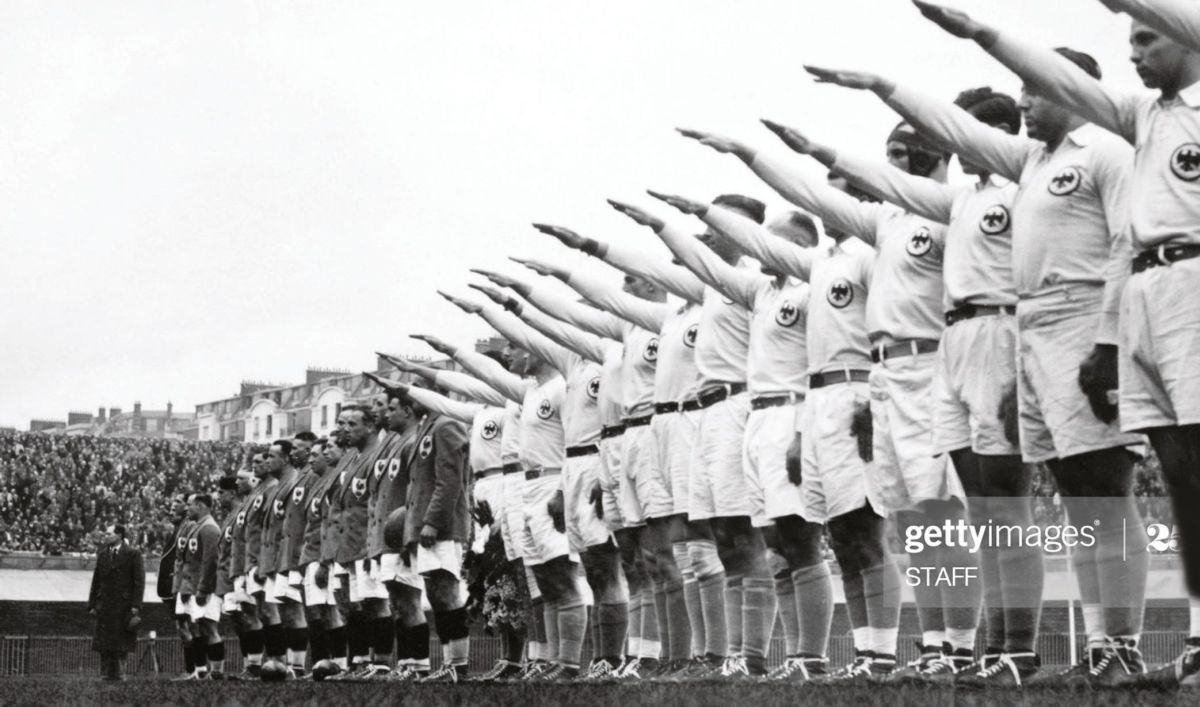
It’s March 24, 1934 in Hannover and a capacity 15,000 crowd has turned up to watch the fast developing German XV tackle France. Adolf Hitler had become Chancellor in January, 1933 but was not yet president and fuhrer. The direction of travel though was very clear and Germany’s sporting teams have already adopted the Nazi salute. It was considered an ominous sign for the future and quickly became synonymous with a poisonous regime.
What’s the story behind the picture?
The real story here is why the game is being played at all. Up until 1931 France had been a growing power to reckon with in the Five Nations; indeed in that last tournament they had distinguished themselves with a fine home win over Ireland and a 14-13 victory over England in what was to be their last Championship game for 16 years.
French rugby was beginning to go places, but it was out of control at club level. Professionalism in all but name was rampant. US Quillan, little more than a village in south east France but famed for its hatmaking factory, had stunned the rugby world by reaching three consecutive French Championships, winning the title in 1929 when they defeated Lezignan.
Millionaire Jean Bourrel, whose factory employed just about everybody in the village, used his wealth to buy in big name players with his cheque book enticing many top players from Beziers, Narbonne, Perpignan and Carcassonne. Some Rugby League players in the region also discovered they could earn much more playing Union. Quillan were not a solitary case, but their morphing in a matter of years to a championship- winning team was the most startling and newsworthy.
There were other outrages to factor in. French club rugby was becoming incredibly violent with deaths on the field and massed brawls among fans. Referees were threatened with physical violence and bribed. It was a shambles and at the end of the 1931 Five Nations the Home Unions said enough was enough. France were to be banned from the Championships indefinitely.
What happened next?
France was a major rugby nation with nowhere to go but they swallowed their pride and decided to set up the Fédération Internationale de Rugby Amateur (FIRA) which was an alliance of the leading rugby nations on continental Europe. France would reinvent itself as the key figurehead rugby nation in a confederation of countries where rugby had a decent toehold.
The initial members were Italy, Spain, Belgium, Portugal, Catalonia, Romania, Holland and Germany. Catalonia were later forced by Franco to merge with Spain.
With regular high-profile games against France, a number of those nations started to quickly improve, notably Italy and Germany, and the annual FIRA competition became quite competitive. France’s annual game against the Germans became quite an event and the previous year a 25,000 crowd had seen France win 38-18 in Les Blues only Test of the year.
Now back at Hannover the improving Germans really had the French in their sights but, in a much closer game, slipped to a 13-9 defeat. Among their players was an exceptionally talented scrum-half who Adrian Stoop at Harlequins -who regularly toured Germany – considered to be as good as any in Europe.
Much encouraged, the German authorities pressed hard for rugby’s readmittance to the Olympics for their Berlin Games in 1936. It was too late for that but they did twist the IOC’s arm and allow rugby to be played as a demonstration sport with the 1936 FIRA Championship effectively transferring lock stock and barrel to Berlin. At the Games Germany claimed a notable 19-8 win over Italy and again gave France plenty of hurry-up before losing 19-14.
Why is the picture iconic?
It’s a startling image on a number of fronts. A rugby team enthusiastically doing the Nazi salute will be news to many but so will the mere fact that Germany once regularly played France in well-attended internationals.
Despite the salute, however, the German team hasn’t quite submitted to the full Nazi propaganda machine. On their white shirts is the single headed Eagle symbol of Imperial Germany although within a couple of years it had been combined with Swastika and a wreath of oaks leaves.
Look at the thick leather belts with metal buckles the German team are wearing. That would never be allowed on health and safety grounds.
Meanwhile that is a very decent crowd gathering on the terraces.This is a proper sporting occasion. You don’t get crowds like that in Germany these days and, not for the first time, rugby has to reflect on a missed opportunity.
Footnote: Germany continued to improve throughout the 1930s with regular wins over Romania, the Netherlands and Belgium while there were further wins over Italy in 1937 and 1938. Finally in March, 1938 came the most notable result in their history, a 3-0 win over France with fullback Gustof Isenberg kicking the solitary penalty. Soon after the world went mad.


Autumn Internationals
What is the Nations Championship? Format, fixtures and how rugby’s new tournament works








The best betting sites