

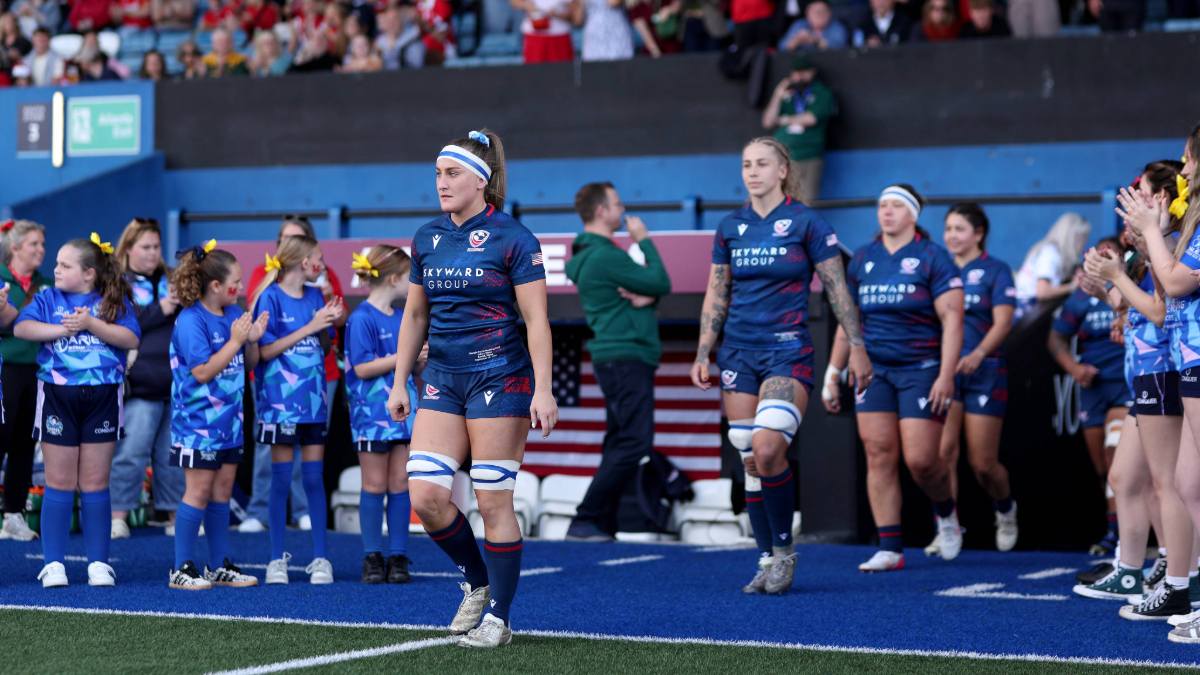
By Jacob Bassford
In short, this WXV series has been incredible.
Not just from an English perspective with the breathless draw with Canada and the last-minute win over the Black Ferns.
Across WXV, the quality of matches has been superb. For this piece,
I argue we should be paying closer attention to the USA.
For exclusive stories and all the detailed rugby news you need, subscribe to The Rugby Paper website, digital edition, or newspaper from as little as 14p a day.
A sleeping giant stirring
For those of who are still unfamiliar with women’s rugby, the Eagles have always been a major player in the international game.
World Cup winners in the inaugural tournament in 1991 and finalists in the next two in 1994 and 1998, the Americans’ place at the top of World Rugby was supplanted when the more traditional women’s rugby unions began to take women’s rugby more seriously in the 2000s.
Yet, the Eagles never went away and were World Cup semi-finalists as recently as 2017.
Since that tournament in Ireland, inconsistency and waywardness have characterised the US women’s team in the last decade, but this WXV series suggests that we could be seeing America once again become a real force in women’s rugby union.
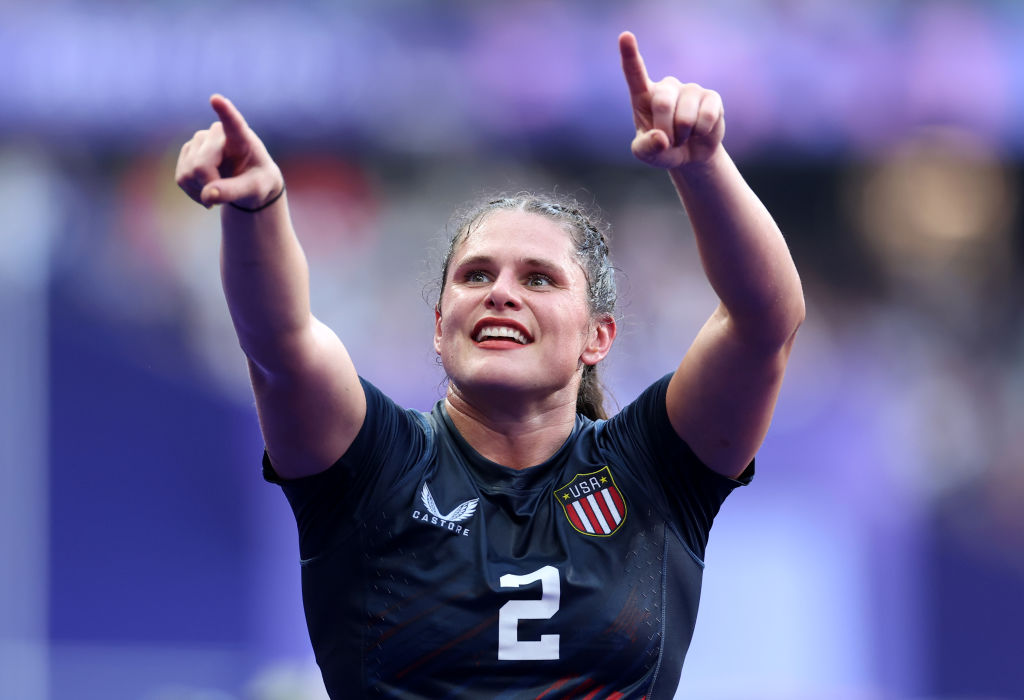
PICTURES: Getty Images
Building a new Eagles
After the 2025 World Cup, Jack Hanratty became head coach of the Eagles.
Previously coach of the Canadian Olympic Sevens team that won a silver medal at the 2024 Olympic Games, Hanratty turned to Sevens to form the basis of his new Eagles side.
On one hand this seems relatively straightforward, Sevens rugby in the US is the more popular format, as well as the better funded as an Olympic program.
Furthermore, in the shadow of Ilona Maher’s star popularity, it’s easy to forget the bronze-medal winning Olympics women’s Sevens team in 2024 was full of ballers across the team.
That being said, relying on Sevens players can have its drawbacks.
The two big issues are defensive systems and backfield play.
You could be extremely talented at scoring tries in Sevens, but if you cannot run an international level defensive formation or cover the backfield properly to field contestable kicks or field potential 50/22s, you will struggle in the fifteens game.
And the USA have at times looked clunky under Hanratty – they have lost one match to South Africa (a team still three or four places below them in the World Rankings) and were unable to compete with New Zealand or Canada in this year’s Pacific Four Series (more colloquially known as Pac Four).
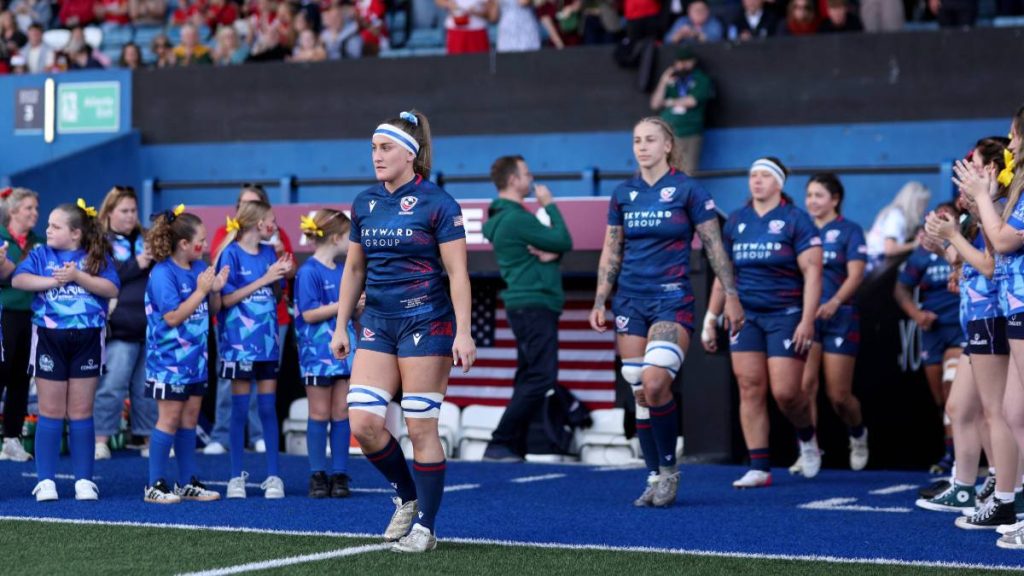
The forwards are leading the way
Yet whilst coached by a Sevens specialist and full of Sevens players, it is the pack and the rolling maul – two firmly 15-a-side elements of the game – that is seeing the US reach a three-game win streak for the first time since the 2006 World Cup.
When playing Ireland, the Eagles looked down and out with a 19-point deficit.
However, their rolling maul and ability to get over the gain-line in tight exchanges against the Irish defence saw a remarkable and unexpected victory over a much-fancied Ireland – all five of their try-scorers were in the forwards.
Since their victory over South Africa in July, 11/14 tries have been scored by forwards, with just three tries coming from the backs.
These tries are not a result of forwards hanging out on the edge and running it in from deep either, these are tries from mauls or the pack bashing the door down in the tight.
Power up front
The USA have not always been traditionally epitomised with a huge pack.
Their World Cup win in 1991 and successive final appearances in 1994 and 1998 was attributed to superior athleticism and speed of play rather than dominant forward play.
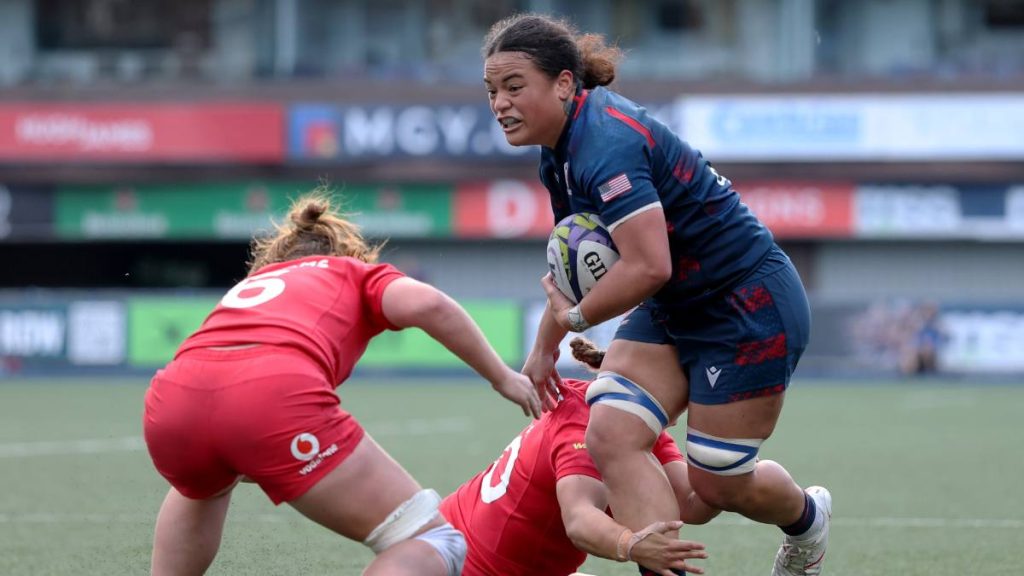
Nonetheless, with stalwart loosehead Hope Rogers still operating at a world-class level, and Keia Mae Sagapolu Sanele emerging into a proper Test-quality tighthead who can match her rampaging runs with scrummaging nouse, you have a starting front row that can hold its own against the majority of the big teams in women’s rugby.
Hann Humphreys has done well to transition from the Sevens game into becoming your ideal nuts-and-bolts blindside flanker, and the back-row with them, Georgie Perris-Redding and the barnstorming Freda Tafuna (bagging tries for fun at the moment) feels incredibly balanced and settled.
A team finding its identity
This is the thing for me with the USA (and I don’t want to jinx it) but the direction, coaching, philosophy and selection of the team feels very settled – something you have not been able to say of this team in the last 10 years.
The previous back-row featuring Rachel Johnson and Kate Zackary were no slouches themselves, so the Eagles coaches can be commended for replacing quality with quality in this area.
Finally – although she has being playing a bench role in this campaign – in Erica Jarrell-Searcy the team has a fantastic captain.
A player who went viral for her solo try against England in last year’s world cup, she is the perfect fit to lead this team.
EJS does not overcomplicate things as captain – she’s understated, she inspires, she leads, her team follows her into battle.
With Jarrell-Searcy at the heart of this pack, the USA have something to build off.
England awaits
The forwards held off South Africa in July, before bailing the Eagles out in an almighty 19-point comeback against Ireland in WXV.
After seeing off Wales (just), USA face two tests against Italy before taking on the Red Roses at the end of October.
It is not unreasonable to assume – particularly playing at home – that the Eagles will be five out of five heading into their match against England.
The Red Roses will absolutely be favourites, but we could be looking at the closest match between two very old rivals for the first time since that semi-final in 2017.
The foundations are there
In the longer run, there is cause for optimism for USA supporters.
The domestic league, Women’s Elite Rugby (WER), will be entering its third season.
Whilst the majority of the star players still play in the PWR or in France‘s Elite Une, as the competition grows it will be interesting to see how it performs as a feeder for the national team, and learn from the mistakes of the men’s MLR competition.
Meanwhile, the collegiate system – which has long produced some of rugby’s finest international players due to the legacy of Title IX1 – is still going strong.
The aforementioned Tafuna and fly-half Bella Vogel have been plucked straight out of university rugby for international honours.
A lot still needs to go right for the Eagles for them to truly be consistent at the top level in women’s rugby.
Plenty of external factors outside of rugby, union politicking over Sevens and fears of WER repeating the mistakes of MLR could all easily derail optimism.
International rugby is used to the USA floating in-between the first and second tiers of women’s rugby, but perhaps driven by their mighty forward pack, the Eagles could be back to the top echelons for the first time in over three decades.
This article can be found HERE
READ MORE: James Pater following in George Furbank’s footsteps at Northampton Saints



The best betting sites



















You must be logged in to post a comment Login