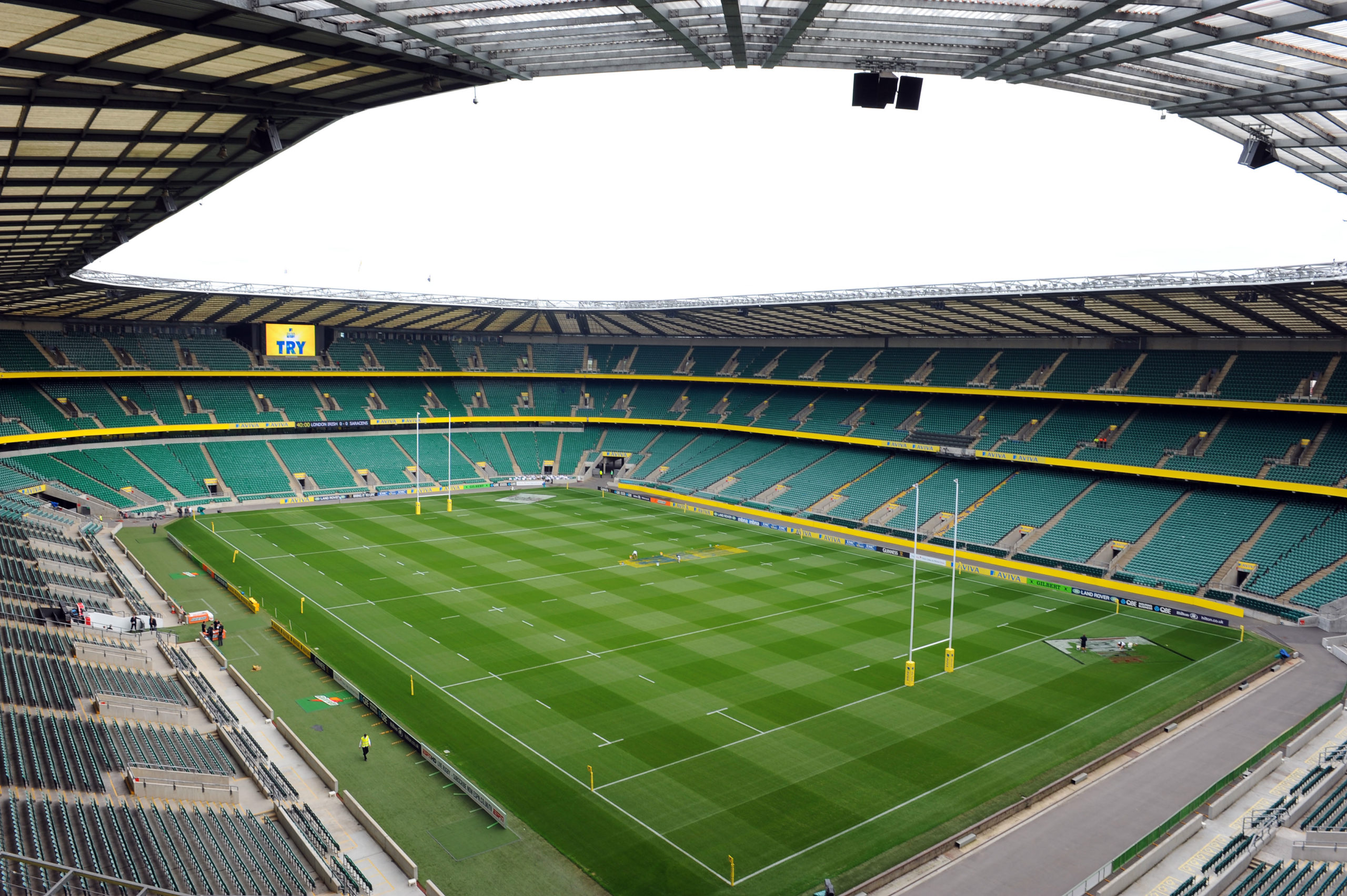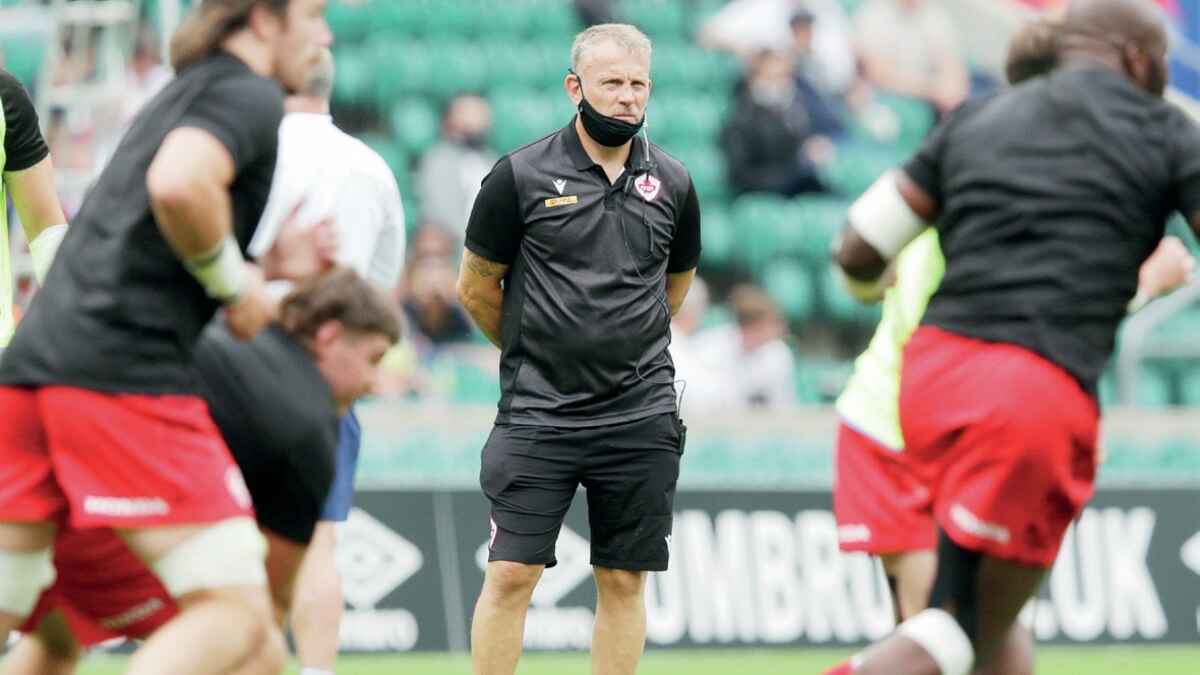


Twenty years have come and all but gone since a Welshman from Blaina prepared Manchester’s champions-elect for their coronation in one of Twickenham’s more memorable Premiership finals: Sale 45, Leicester 20.
Fifteen years have come and gone since the same Welshman, this time on a global stage in charge of Russia’s World Cup baptism against the USA, found a stranger holding court post-match in the dressing-room flanked by armed guards, unaware that the burly bloke in question was Vladimir Putin’s political master.
In the no-nonsense direct approach of his native mining community, the man from Blaina was about to clear his throat when, a split-second away from provoking a diplomatic incident, he recognised the unannounced guest as Russia’s president Dmitry Medvedev.
In a flash, Kingsley Jones performed some verbal gymnastics almost as impressive as the physical ones, a trademark speciality from the openside of the scrum in days of yore.
Professionalism
The identification of the supposed gate-crasher as His Excellency had an instantaneous impact on Jones’ words and his tone of voice.
His opening gambit changed from open hostility (“Oi, excuse me, what are you doing in here?”) to polite gratitude (“Ah Mr President, thank you for coming. I hope you are as proud of these players as I am.”)
Post-professionalism, nobody can have done more to enhance the cause of the Welsh coach on as grand a scale for so long.
For all the nagging fear of a job dependent on results, he never allowed the ruthless nature of professional sport to dilute his sense of fun.
Jones, 55, took it with him wherever coaching took him: to Doncaster Knights (one season), Sale Sharks (seven seasons), Russia (three seasons), Dragons (four seasons), Canada (seven seasons): a CV stretching more than halfway round the world from Vladivostock to Vancouver.

PICTURE: Getty Images
Farm
These days, he can be found about as far as it’s possible to get from the madding crowd, at home on a farm in his native Monmouthshire.
After two decades devoted to the tricky concoction of winning rugby matches laced with dollops of laughter along the way, Jones is now all about his ducks and geese and their capacity for laying eggs.
He takes their collective welfare seriously enough to rig up a novel form of security which has hitherto done the trick as a deterrent to foxes and other predators.
“I’ve put out a Talk Sport radio and keep it on all night long,” he says. “Not loud enough to keep us awake, but loud enough to keep the livestock safe.”
Jones has been out of full-time rugby employment for the first time since his seven-year stint in charge of Canadian rugby ended two years ago this summer.
“This is the longest period that I’ve been out of the game since it went professional and that’s over 30 years ago.
“I finished playing in May 2003, and in June 2003, I started at Doncaster as director of rugby. So after that length of time, you can imagine that life outside rugby has been a challenge.
“We bought this farmhouse in 2012 and the farm keeps me busy. As well as the livestock, I’ve got a big pond full of fish and it’s a change to be doing something completely different. I’m unsure as to what the future holds.”
Storm
Few, if any, can match Jones when it comes to people skills, a trait which he inherited from his later father, Kingsley, senior, famous in All Black folklore for emigrating from Blaina to coach in the Auckland area where he discovered a gigantic teenager, Jonah Lomu.
Instead of The Good Life and lending his expertise to Monmouth RFC, Kingsley junior might have been caught in the eye of a storm which has been raging around the Welsh game all season long.
Encouraged to apply for the Director of Rugby position advertised by the WRU last year, he had a final interview shortly after England‘s ten-try romp at Cardiff 13 months ago.
Dave Reddin, England’s fitness coach at the 2003 World Cup, got the job instead.
Jones was less than heartbroken at the time, even more so now.
“Looking back, I feel I may have dodged a bullet,” he says. “I wouldn’t have wanted to be at the centre of a fight over killing off at least one region and being caught up in the crossfire.
“When I left that last meeting, my heart was telling me to do it. At the same time, my head was telling me: ‘This job is not for you’.
“At that point, the Union’s stance was that there would be four teams. An agreement between the Union and the four was about to be signed.
“Then the (Cardiff) Blues went into administration, Scarlets and Ospreys decided not to sign and the Union suggested two would be the preferred number.
“Then we ended up with three. I wouldn’t have wanted to be the guy having to decide something as devastating as that without all the facts.”
Going back
He added: “I believe we need three teams, assuming we get the coaching and player development and the pathways right, plus alignment from community level to the professional game.
“You can understand the Ospreys argument about community. A future without a fully professional team in Swansea would have a savage impact on the game at all levels.
“The longer we stand still on this issue, the more we’re going back at a rate of knots.
“The Union’s approach gives the impression that financial considerations have been prioritised. While cost management is obviously important, it would be beneficial to ensure equal attention is given to the wider value and long-term impact.
‘’I think I have a lot of experience to offer and I’d love to do something that really excites. I’d like to be involved with the WRU at some stage.”
Since returning from Canada, he has been to Japan at the behest of their national coach, Eddie Jones, and to New Zealand for a renewal of his friendship with Graham Henry.
The Welsh Jones is an associate tutor at Cardiff Metropolitan University, where he is studying for a doctorate in Leading Change and Management.
Meanwhile, back at the ranch, Jones is about to diversify.
“We’re going to get some beehives next,” he tells me. “So I’ve got a lot to learn about bee-keeping.”
He has the advantage of knowing a thing or two about the two-legged version of the wasp.
During his season of seasons at Sale, six Charlie Hodgson goals and a Jason Robinson try swotted Wasps away in the Premiership semi-final.
READ MORE: Peter Jackson: Time for George North to face the final curtain