

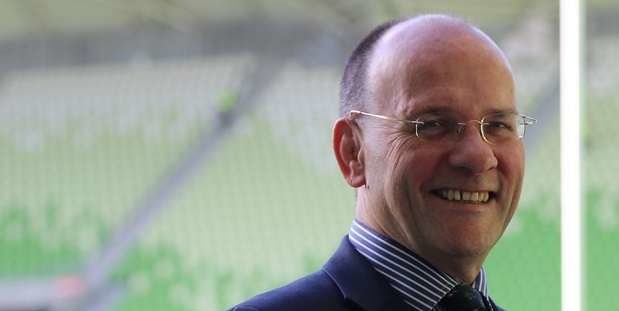
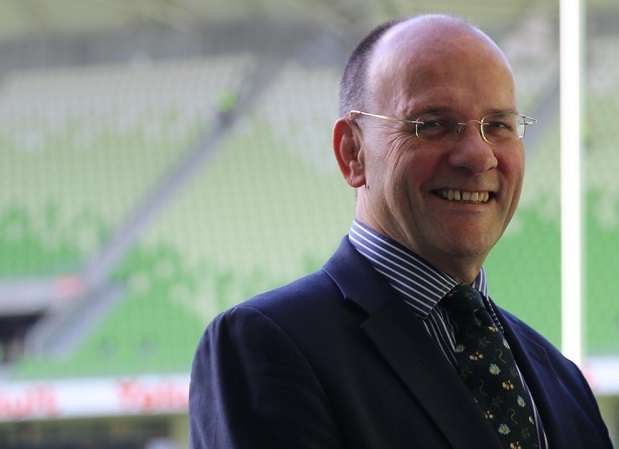
 Mark Evans has never forgotten his first night of European football, watching Cardiff City beat Real Madrid from the blue-collar Grange End at Ninian Park.
The result (‘one-nil, Brian Clark 47 minutes’) left a lasting impression on the 12-year-old boy. It fired his imagination in pursuit of the improbable and the implausible, as good an explanation as any for what happened when he left Wales for another initiation, into the strangely anonymous world of London club rugby.
The shape of the ball changed but the ultimate goal remained. Without having the faintest clue as to what lay over the rainbow, Evans spent the first 20 years of his adult life laying the foundations of a European triumph more outrageous than his home-town team catching Real on a bad night in the spring of 1971.
A decade later, the English game still hadn’t got round to organising a league or anything vaguely resembling it because the King Canutes running the RFU thought all that smacked of professionalism. A European Cup? Over our dead bodies, old boy.
Even had such a thing existed back then, it would never have been mentioned at the club where Evans chose to hang his hat. The notion of European rugby being played on a parks pitch in London suburbia would have been too ridiculous for words.
Evans, then living in Palmers Green, pitched up a little further along the Piccadilly Line in Southgate ready to give the club around the corner a try. The new hooker asked for a game without professing his missionary zeal to convert a club happily chugging along far from the beaten track.
The Cardiff City fan had sought refuge at Bramley Road, home of Saracens. “I was living with a mate from Cardiff,” Evans said. “We knew we had to start playing again but where? Where shall we play?
“We went through the London clubs until we got to Saracens. We’d heard of them because their results used to appear on Grandstand. And their ground was only a couple of miles away.
“It didn’t matter who you were, you played your first game in the fourths. They had seven teams and you went up and down according to ability. I started off against Barnet seconds on one of the back pitches at Bramley Road.
“My mates in Cardiff would ask: ‘What’s it like? ‘And I’d tell them: ‘The standard is really good but there’s nobody watching. The touchlines are empty. That was in 1981.
“Rugby in London then wasn’t a spectator sport. It was a participation sport whereas where I came from it was both. My dad would take me to Ninian Park one Saturday and the Arms Park the next so I was used to being part of a big crowd.”
Evans and Saracens became such an item that by the time they parted two decades later their Welsh recruit had gone from amateur player to prototype professional coach, then director of rugby, giving up his position as deputy head at a comprehensive school.
He was there for the lunch that gave the club the financial clout to shoot for the stars. At the Paris summit, in August 1995, the game went ‘open’ and the RFU, wretchedly ill-prepared for the professional revolution, were still trying to make sense of it all.
Two months before the revolution in Paris, Nigel Wray had ensured Saracens would come flying out of the blocks into the new professional game.
“We met at a little Italian restaurant near Nigel’s office in the West End,” Evans said. “My first impressions were of a charming man with impeccable manners, a nice guy, very successful in his field who clearly enjoyed his rugby.
“So just as we got to the dessert, he said: ‘Right. I’m prepared to invest £3m.’ I nearly fell off my chair. I thought: ‘Wow! This is going to be some adventure.’ We would be blazing a trail. You look back and think: ‘Gosh, that was interesting’.”
Wray gave his new team an old juke box, the dressing-room a lick of paint, new showers and a few household names. His cheque-book drew some of the biggest to Bramley Road, none bigger than Francois Pienaar who remembers ‘training ankle-deep in sludge’ and the makeshift ‘floodlights’ – ‘poles with torches tied to the top’.
Evans made the best signing of all, a three-dimensional back row forward whom Sarries found on their own doorstep, Richard Hill. He can recall Wray telling the players in late 1995: “I want to see Saracens playing against Toulon in the semi-final of the European Cup in front of a capacity crowd.”
Nineteen years later they went one better, against Toulon in the final in front of almost 70,000 in Cardiff, albeit in a losing cause. Now that they have been duly anointed as undisputed champions of Europe, some will wonder why it took them so long.
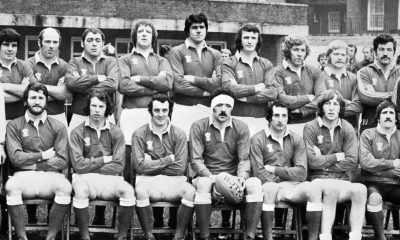
Evans, left, frozen out of coaching during his last year amid tensions with Pienaar, left in 2001 to start working the odd miracle for Harlequins as chief executive.
“I decided it was time to go,” he said. “I’ve never commented on why. I had my reasons. Let’s just say I was more comfortable going than staying.
“Most of us thought Saracens would dominate English rugby after winning the Tetley’s Bitter Cup in 1998. Instead it all unraveled fairly quickly which was a shame. Watching from afar, they seemed to lose their way for a long time with a lot of changes of coach and almost as many changes of style.
“Ironically, I feel a stronger emotional attachment to Harlequins. I was there for 11 years, transforming it from what it was to what it is. But you don’t stay somewhere for 20 years, as I did at Saracens, without being very fond of the club.
“I’m really pleased for people like Nigel Wray, Nick Leslau and Steve Thomas who were there from the beginning. Nigel described himself last week as ‘the most impatient patient man in the world’.”
He has had to be. Evans, back in England after three enlightening years in Australian Rugby League, will hardly need to be advised that the Fez Heads’ are more likely to reign over Europe ad infinitum before his Bluebirds ever get round to beating Real Madrid again.


International Rugby
2026 Six Nations analysis: What we learned from this year’s tournament



The best betting sites



















You must be logged in to post a comment Login