It’s been hailed as the best ever Six Nations because of its topsy-turvy nature, unpredictability, and exciting edge-of-the-seat stuff, as well as the tournament in which the most tries have been scored.
If you look at France beating Ireland, Scotland beating France, Ireland beating Scotland, England beating Wales, Wales beating Italy, and Italy beating England and Scotland, it tells the story.
Whether it’s the best ever, I’m not sure, but it was probably the most unpredictable.
What was predictable was France being made pre-tournament favourites, but after that, nothing else was.
Electric pace
Overall, France lived up to what we thought they would, but England didn’t.
Ireland showed that they are still contenders in the Six Nations and at World Cups, but Scotland, for all the hype, still got hammered by Ireland.
The Scots were stuck on three wins (again), and four wins continues to be a threshold they cannot reach.
Italy showed far greater consistency for most of the tournament, but to get blown out in the first half against Wales suggested not only that they were tired, but also lacked the strength-in-depth required to get above fourth in the table.
My player of the tournament was Louis Bielle-Biarrey.
As a finisher, he’s got the lot, but what’s so impressive is the way he combines electric pace with great anticipation, reflexes, reading of the game, and judgment.
His four tries against England were the icing on the cake, as he again scored in every round of the tournament, giving him an incredible 29 tries in just 19 Tests.

Top billing
Others who deserve top billing for the 2026 champions are Matthieu Jalibert, who was consistently very good at fly-half for the French, and Charles Ollivon, whose versatility in switching from the back row of the French pack to lock was awesome.
Elsewhere, Tommaso Menoncello was outstanding at centre for Italy, while Jack Dempsey and Darcy Graham were a persistent threat for the Scots.
Jack Crowley did an impressive job for Ireland, steadying the ship after taking over the fly-half shirt from Sam Prendergast, and steering them to second place – and so close to winning the title if England had hung onto the lead after Tommy Freeman’s 76th-minute try.
As for England, I said a couple of years ago that although Ollie Chessum was playing mainly at lock, he had enough mobility to play at blindside.
Chessum showed against France that he’s a true big beast at 6, and maybe that’s where he should be.
I liked Freeman in attack at outside centre, although his defence is still a work in progress.
He proved that he can beat players and score tries whether he is at 13 or wing, and offers real versatility.
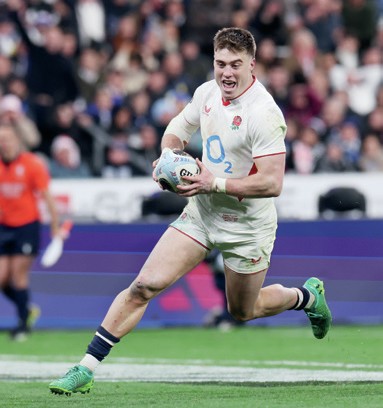
Positive: Tommy Freeman scoring against France
Direct
However, I’m not convinced by any of England’s inside centres during the Six Nations.
It’s hard to understand how Max Ojomoh had a great game against Argentina, but hasn’t been given another chance since autumn.
It was a blow that Ollie Lawrence picked up a knee injury and missed the final two games.
When fully fit, he has an intimidation factor as a direct runner and is one of the few backs who can consistently get England over the gain line and keep defences honest.
Being direct is England. It’s what they thrive on, and it’s where they need to focus.
They may be guilty of over-analysis of winning competitive high kicks when England’s true identity is being very direct.
If you look at Bath, Northampton, and Saracens at their best, they are direct rather than coast-to-coast.
However, it means England having the confidence to play with the ball out of their own half, like France and Ireland do.
Streetwise
The problem they have is that they appear to be surprised when they run out of support players, usually because, in phase play, they commit too many bodies to rucks.
England need to be more streetwise rather than playing to a roadmap.
They should uncomplicate it by having only two moves off set-piece, rather than 10, and be prepared to call moves on the hoof so that defences do not see them coming.
Unleash yourselves, and don’t be satisfied playing kick-chase, because anybody can do that!
Why did it take England three losses to find themselves again in Paris?
I’d love to know what went on in camp during that period, and whether what they did before the France game contrasted with what went before.
Hopefully, we will find out from the debrief over the next two weeks. The RFU have told us they are doing it, so they must ensure that they tell us their conclusions when it is finished.
Right man or wrong man for the job?
After four defeats and a fifth-place Six Nations finish, it will be mainly about whether head coach Steve Borthwick is the right man in the wrong job.
He’s a dedicated coach with a very good reputation, but should he be the front man in a manager-type role?
In some international or club set-ups, you’ve had directors of rugby picking the team rather than coaches, but if the outcome is that Borthwick continues to select the team, then effectively he’ll still be in charge.
The France game is where England’s standard needs to be, and this review has to reveal what went wrong and where England have to improve.
Why did some players look off their game? What’s the team culture?
The review has to remember that players who are picked will be happy, and players not picked will want to know if their responses are confidential.
It has to find out what wasn’t right, because England were so off in the games against Scotland and Ireland that they couldn’t recover.
It was like they were stuck in quicksand and couldn’t get out. In the 12-match unbeaten run, the intensity was there, and the rush defence was there. After the Wales game, it wasn’t.
Physical/mental struggles & ill-discipline
The conditioning and medical staff should have known before the tournament if players were below par physically.
Mentally, it’s a different thing, and the big question is, why did England give so many penalties away?
That’s about team culture, because in successful teams, there is an expectation from within the group to keep it going.
The discipline element is so important, and the attitude in my time was, “you don’t want to let anyone down”.
Today, with yellow cards and 20-minute reds, I would rather concede a try than get a yellow card, because usually that translates into the opposition scoring two tries.
Discipline is misconduct, and you’ve usually got serial offenders in a team under pressure. It’s usually also the worst teams giving away the most penalties.
Penalties, and Thomas Ramos, was the difference between France winning and losing against England, and regaining the Six Nations title, with the French full-back hitting the target with one of the great last-minute pressure kicks.
If you give penalties away against Ramos, it’s like giving them to Jonny Wilkinson, Neil Jenkins, or Leigh Halfpenny, because he just doesn’t miss.
Showboating problem
Ramos is invaluable, and although he’s a bit excitable in certain situations, when he’s goal-kicking, he’s in the zone and deadly.
One sideshow the review should consider is Henry Pollock’s showboating. Pollock taking his pulse after scoring was quite funny, but going from that to running half a mile for an in-your-face celebration, and shushing the Stade de France crowd, like in football, in an attempt to wind people up, is not in rugby union’s code of values.
Kids copying that is not what’s wanted, and it needs to go.
Another thing that doesn’t sit right is the sight of backs sprinting in from 40 yards to celebrate a scrum penalty.
A quick pat on the back is one thing, but when it turns into whooping, cheering, and sometimes having a go at the opposition, it feels off.
Time and a place
At times, it looks like it’s done purely to wind teams up rather than respect the contest.
There’s a time and place. If it’s the last scrum of the match, your pack wins a penalty, and the kick goes over to win a tight game, fair enough, celebrate.
But not before the job’s finished. Let’s be honest, most of the lads charging in haven’t got a clue what’s actually happened technically in that scrum anyway.
Back in the day, if a scrum penalty was won, the acknowledgement stayed within the eight who earned it.
Maybe a nod, a quiet word, a punch of the air. Nothing over the top. More often than not, the opposition knew they’d been done and got on with it.
We don’t need the theatrics. Let the forwards do their job, respect the moment, and keep hold of the values that have always set rugby apart.
READ MORE: Jeremy Guscott: Stunned! That’s my reaction to England’s Six Nations defeats


Autumn Internationals
Wales 28-21 Japan: Lightning Louis Rees-Zammit left with little in support

Autumn Internationals
England captain Maro Itoje urges his side to win back the fans ahead of Australia clash


Autumn Internationals
Steve Borthwick: I know vast majority of my England selections for 2027 Rugby World Cup


The best betting sites