

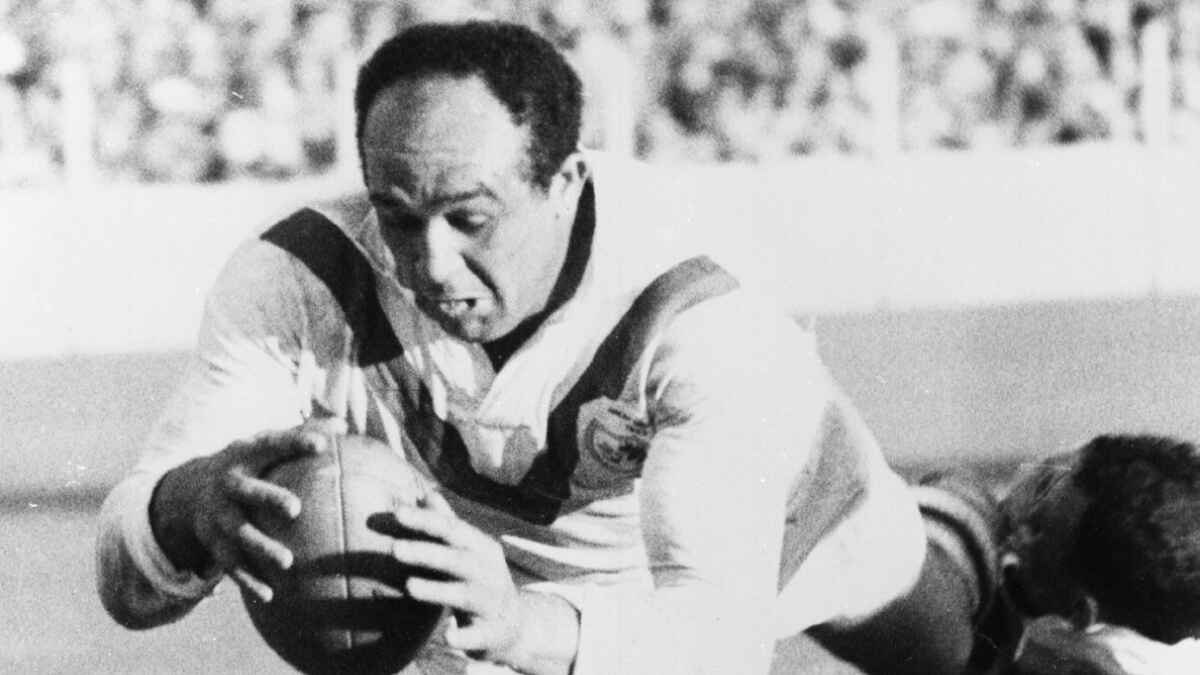
In the most exclusive of league tables as reserved for footballing knights of the realm, Sir Billy Boston stands above both Sir Alex Ferguson and Sir Gareth Edwards.
Their ceremonial ranking, based on the number of statues sculpted in honour of their achievements across the three major codes, gives the boy from Tiger Bay pride of place on three: one clear of football’s most decorated manager and two more than Union’s player of the 20th century.
And to think that once upon a time long ago, on Friday the 13th of March 1953, two strangers armed with a brief case stuffed full of white five pound notes left the teenaged Boston in tears at the family home in Angelina Street, Butetown.
As Wigan chairman Joe Taylor and vice-chairman Billy Gore weaved their way out of Cardiff‘s dockland on the long drive north, Boston felt a crushing sense of regret at the enormity of what had transpired, a realisation that his life would never be the same again.
Regret
“I sat down and thought: ‘My God, what have I done?”’ he told me years for Triumph and Tragedy, a book on 17 all-time greats of Welsh sport.
“When the Wigan people left the house late that night, I cried at what I’d done.”
He had signed to play a game he had never played, let alone seen, for a club in a place he had never heard of.
In the vindictive way Rugby Union ostracised those who took the Rugby League shilling by declaring them personae non grata, Billy knew what he had sacrificed.
Two days earlier, he had scored six tries for the Royal Signals against the Welsh Guards in the Army cup final at Aldershot.
Wigan having tracked the embryonic superstar with due diligence headed for Cardiff aware that Boston would be home weekend leave from national service.
“They told us who they were and that they would pay me one thousand five hundred pounds to sign for Wigan,” Boston told me back in the day.
White fivers
“The chairman opened his briefcase and put the money on the table: £1,500 in white fivers. I’d never seen so much money.
“My mother didn’t bat an eyelid. I looked at her as if to say: ‘How are you going to get me out of this?
“I took her out of the room and told her: ‘I don’t want to go anywhere. Get rid of them.’
“She said: ‘I’ll get rid of them alright, son. Leave it to me.’
“So my mother went back into the front room where the Wigan directors were waiting. ‘Give me three thousand pounds,’ she says. ‘And he’ll sign right away.’
“I thought that was a very clever way of getting rid of them because there was no way they were going to stump that much.
“I wanted to stay in Rugby Union and see how far I could go.”
Best mistake
He added: “Instead of picking up their briefcases and heading out the door, the men from Wigan said: ‘Ok, we’ll give you three thousand pounds – half of it in cash now, the other half over the period of Billy’s contract.
‘’I understood my mother had to keep her word but I knew that I would never play for Wales at the Arms Park.
“I wasn’t bothered about the money and I certainly wouldn’t have paid three grand for someone like me, not for all the tea in China.
“Money didn’t motivate me. I never saw any of the white fivers.
“My mother took them and that was fair enough because she’d brought me up and she had a big family to look after.
“It turned out to be the best mistake I ever made and I’ve been saying that now for 70 years.”
Proud
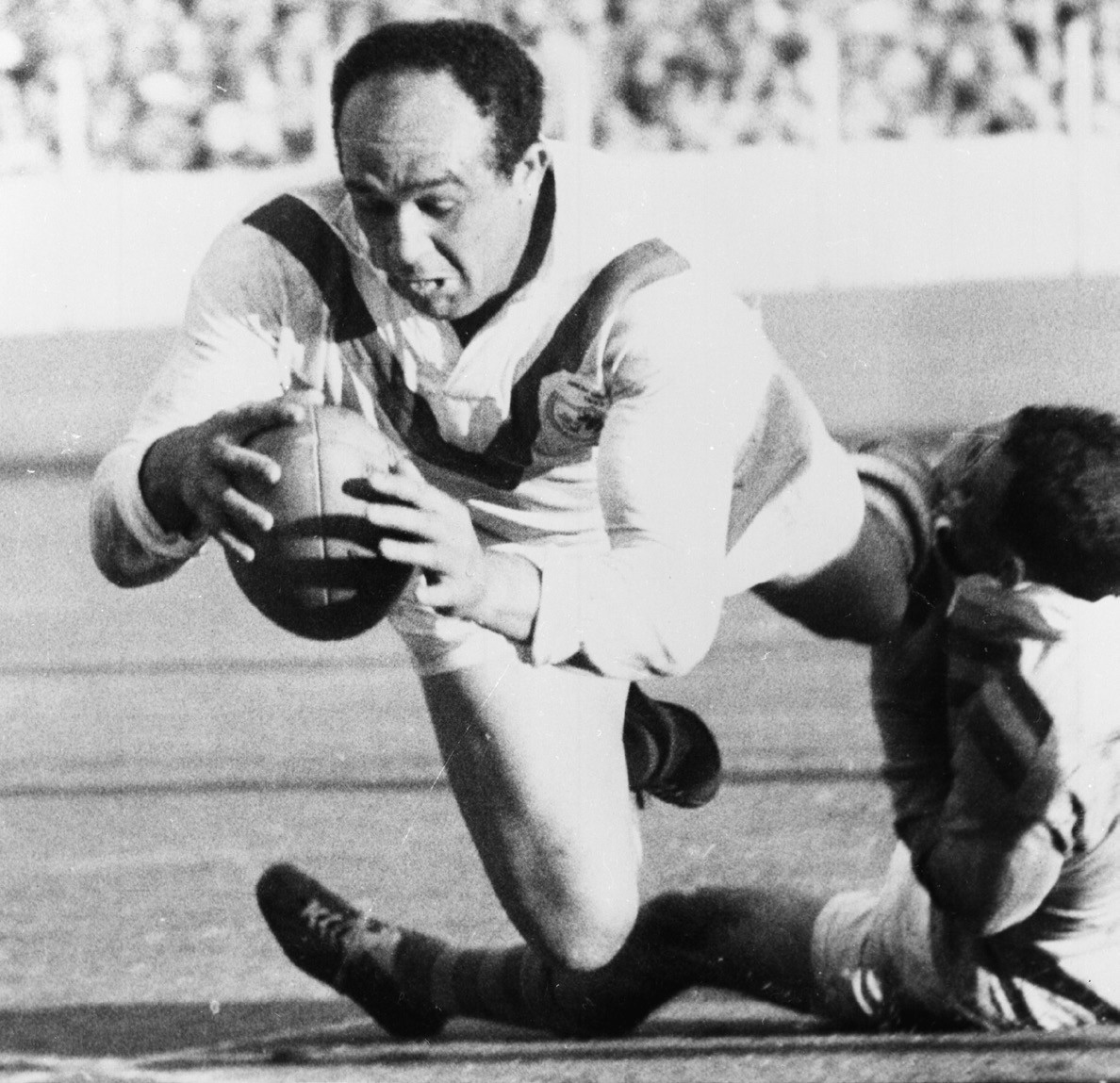
Born halfway down the family pecking order with five brothers and five sisters, Boston would never have believed his ears had he found a soothsayer who really knew his or her stuff.
Imagine the scene with only a crystal ball between them.
“You will do great things,” Billy. “In this place they call Wigan you will be more famous than George Formby and nobody’s more famous in Wigan than George Formby.
“You will be knighted by The King at Buckingham Palace. And before you’re done, Billy, there will be statutes of you all over the place.”
There are three; one in Wigan, his home for 73 years, one at Wembley where he appeared in six Challenge Cup finals and, most recently, one in old Tiger Bay unveiled at Landsea Square on a blazing day three summers ago at a cost of circa £300,000 largely funded by Sir Stanley Thomas.
Billy loved it all the more because it meant standing forever alongside two other local boys who did Rugby League proud, Gus Risman and Clive Sullivan, the three united under the banner ‘One Race, One Team.’
Racial injustice
Boston, who died last Monday at 92, ten years after being diagnosed with vascular dementia, knew more than most about racial injustice, something which he first endured in his native city.
His feats as a prodigious schoolboy talent had been widely publicised, among them his debut for Wales at 16 in a boys’ club match against England at Neath.
So how come he never played for the one club he wanted to play for more than any other, Cardiff?
The late Johnny Freeman, another black player who, like Sullivan and Colin Dixon, found a welcome in League they never felt t home in Union.
“You couldn’t play for Cardiff in those days if you were black,” Freeman said, referring to the Fifties and early Sixties.
“Nobody ever said as much but that’s the way it was. Billy was out of this world as a kid of 15 playing for the Kayaks (the docks-based Cardiff International Athletic Club).”
Incensed at once being refused entry to New Zealand as a member of the Great Britain team, the incident prompted a written apology from their Prime Minister, Sir Keith Holyoake.
Thereafter he refused to play in apartheid South Africa under its racist laws.
Unfailing modesty
What endeared Boston to fans of both codes was the unfailing modesty which accompanied the mountainous total of his tries; 566 in 560 matches, 478 for Wigan.
His humility shone through in something he used to say: “It’s not what I’ve done for Rugby League, it’s what Rugby League has done for me.”
Jim Mills, who did play for Cardiff before embarking on a long League career in England and Australia, described his lifelong pal as ‘a gentleman who would chat anyone who approached because he had time for everyone. Wigan is heartbroken.’
During a moving 30-minute tribute before Friday night’s home match against Hull KR when the crowd gave a tearful rendition of Abide with me, Wigan chief executive Kris Radlinski announced that the seats where Sir Billy and Lady Joan sat would be ‘retired’: “Nobody will ever sit there again.”
The late Ray French, a dual-code England international who became the voice of Rugby League post-Eddie Waring, paid a mighty tribute: “When Billy Boston moved north, Wales lost its greatest-ever Union player.”
Had Wigan not been so fast out of the traps, had Boston stayed to play more than one game for Neath and another for Pontypridd, then got his cap, the old mill town might never have found enough white fivers to buy him…
READ MORE: Peter Jackson: Badlands! Another US team bites dust


Latest News
Top clubs slump in European washout


Latest News
Former Sale lock Andrews dies suddenly, aged 31

Latest News
Malins: New signings made the difference


The best betting sites
















You must be logged in to post a comment Login