THE Prem is now probably on a par with Japan League One in terms of preparing players for the demands of international rugby. It’s why, if the losing, lacklustre performances of most Prem clubs in the first round of the European Cup is a portent, there is a Nations Championship reckoning on the horizon for England head coach Steve Borthwick, and his team.
Whatever the apologists for English rugby say – and there is an army of them – the Prem is not close to living up to the favourite mantra of its TNT broadcaster that it is “the greatest league in the world”.
The defensive failings of Prem clubs have been laid bare time and again, and the open door rugby they showed last weekend in Europe, and in domestic league matches prior to that, should not be up for debate.
For all its pretensions, Prem standards are nowhere near as exacting as those in the French Top 14, which can legitimately claim to be the world’s greatest league. Nor can the Prem claim to be better than the URC, because its multi-national composition produces a wider range of competitive factors.
The blame falls squarely on the shoulders of protectionist Prem owners, and of RFU mandarins, who have allowed them to ringfence English rugby union’s top league from the rigour of promotion-relegation.
This merit-based system demands that teams can defend as well as attack, and that ability is non-negotiable if your international team is to be successful. Instead, by kow-towing to owners who believe wrongly that tries are the sole measure of rugby “entertainment”, the RFU has encouraged the damaging outcome of Prem clubs which are defensively weak as the sole feeder of England’s international player pool.
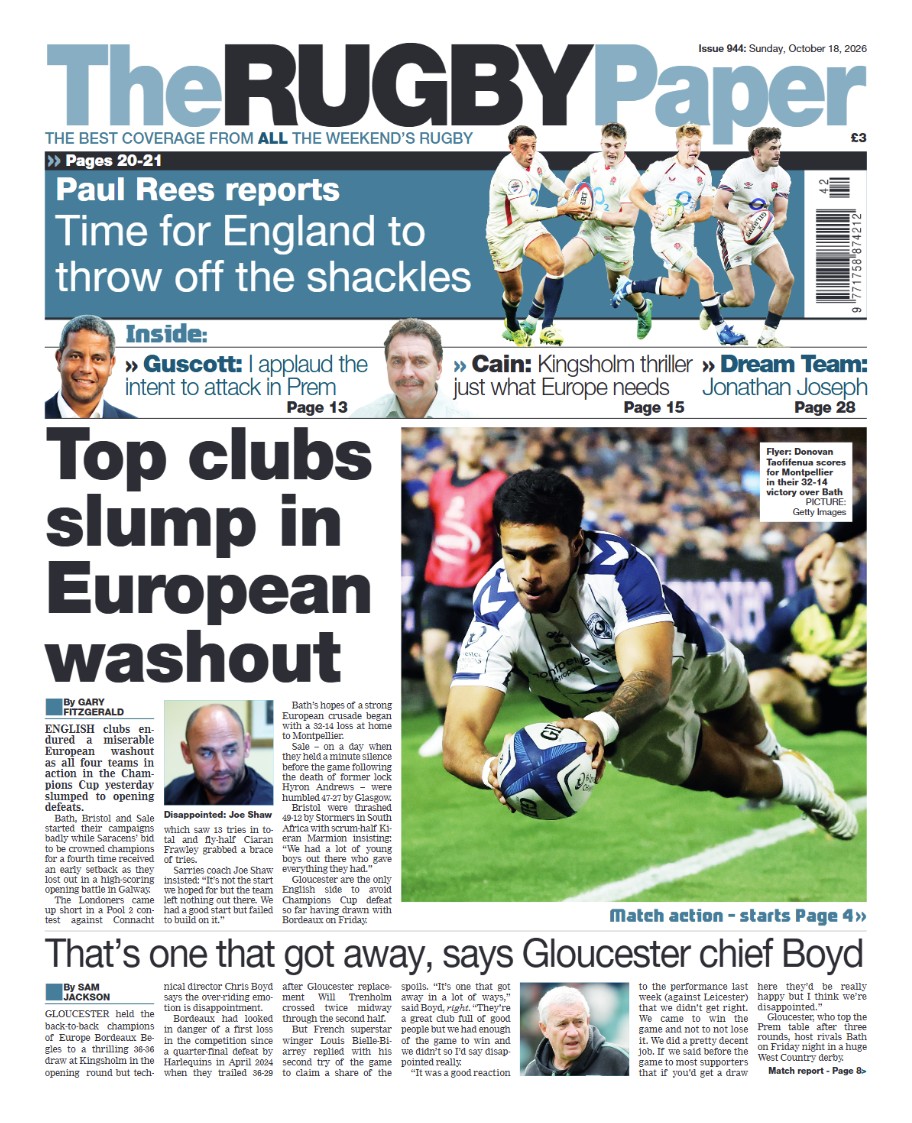
Look no further if you want to know why Prem clubs had a won 1 drawn 1, lost 6 record in the opening European Cup weekend, as well as conceding more points than those in the Top 14 and URC.
For the record, the average number of points they conceded was 38.1! Borthwick must have been in a state of bolt upright shock after the ear-splitting alarm triggered by England’s eight leading clubs leaking tries like a sieve a few weeks before they face Australia and New Zealand.
The case for England’s defence has already been massively undermined by their fifth place finish in the last Six Nations following heavy losses to Scotland and Ireland, and high scoring if narrower defeats to Italy and France.
Add to that a 45-point humbling by South Africa in Johannesburg in July, when the world champions scored seven tries, and Borthwick,and defence coaches Richard Wigglesworth and Joe El Abd, have had plenty of time to work out, theoretically, how to fix the fault line.
“The Prem on a par with Japan League One in terms of preparing players for internationals”
Putting it into practice with so many of their England starting 23, and those in the wider squad, looking so threadbare in defence and short of drive for their Prem clubs, might prove more difficult.
Given that 19 of the 25 players on England EPS contracts come from just five clubs – Northampton, Saracens, Sale, Leicester and Harlequins – and that this is meant to give Borthwick some say in when they play, he must either be bemused, or have agreed to, the rest/rotation of his EPS players in Europe.
The Prem’s lone win came when Northampton struggled to shake off Cardiff despite picking starting half-backs Alex Mitchell and Fin Smith (bench), while Tommy Freeman, Alex Coles, and Henry Pollock were rested.
Maro Itoje, Jamie George, and Ben Earl were all on duty for Saracens when they got a dusting from a more dynamic Connacht outfit, although George Martin was rested.
Luke Cowan-Dickie and George Ford both started for Sale as they were outplayed at home by Glasgow, while Asher Opoku-Fordjour and Tom Curry came on for most of a disappointing second half.
Ollie Chessum captained Leicester in Pau, and Jack van Poortvliet came off the bench, but tight-head Joe Heyes was given the day off as they were outclassed by the Top 14 club.
Bottom of the Prem Harlequins had a 57-19 European Challenge Cup stroll in the park against Top 14 tail-enders Vannes, after including George Furbank and Marcus Smith in their starting line-up – although there was still no sign of loose-head Fin Baxter’s comeback.
Elsewhere, Bath’s Will Stuart and Guy Pepper were on the receiving end against Montpellier at The Rec, as were non-EPS hopefuls Ollie Lawrence and Max Ojomoh. It was the same story for Henry Slade in Exeter’s gutsy trip to Toulouse, where Immanuel Feyi-Waboso was absent due to hamstring trouble. Ellis Genge missed Bristol‘s battering by the Stormers in Cape Town due to an injured wrist. However, in a rare segment of good news, centre Seb Atkinson had a strong game for Gloucester in their spectacular draw with Bordeaux.
The pressing question for Both-wick in all this is why he failed to challenge Prem coaches for rotating/resting England internationals when the European Cup is a higher standard than their league?
Seeing his Test players competing against motivated quality opposition, coping with different refs, and hostile crowds, has to be far more valuable preparation than a ‘defence-lite’ ring-fenced Prem with 10 teams who know each other all too well.
Here is a realistic ready-reckoner of where England are in the light of results over the last year.
The front five is over-rated, and guilty of far too many missed tackles. Despite props making some scrum improvement, both the EPS hookers, George and Cowan-Dickie, lack the energy and effectiveness they had in their prime. Genge should shelve his scrum chat to refs because it is often counter productive.
The back row remains unbalanced. Earl and Itoje, moonlighting at blindside, were outplayed by Connacht’s back row – neither could match Ciaran Prendergast’s vigour. Injury has impacted Tom Curry’s mobility, and it’s time to use Pollock’s match-turning pace to the full at No.7.
Centre is still confused. Atkinson looks good, Janse van Rensburg is battling concussion, Ojomoh and Lawrence did not shine against Montpellier, particularly in defence.
At scrum-half Mitchell is not at his sharpest, and his box-kicking is often too long. He’s currently well adrift of NZ’s Cam Roigard.
The room for raised standards and consistency among Borthwick’s England squad, and its coaches, looks chasm-sized going into the Northern Hemisphere leg of the Nations Championship.
It’s time to fill the void.


Latest News
Resurgent Tigers cut loose to slay Saints

Latest News
England get set for World Cup blast off

Latest News
WRU in financial crisis as losses hit £18.2m



The best betting sites