

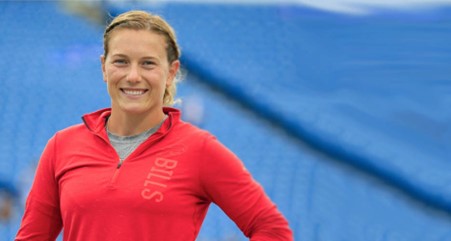
Phoebe Schecter is a renowned diversity & inclusion speaker who has transformed her experience in sport into powerful messages about leadership, self-belief and equity.
Having moved from the United States to the UK, she has spent over a decade embracing risk and pushing boundaries in football.
Her journey offers rare insight into overcoming barriers and finding one’s voice in fields where women are often under-represented.
In her role as chair of the Diversity and Inclusion Committee for the British American Football Association, Phoebe shapes policy and culture with one clear aim: to ensure every member feels seen, heard and valued.
From pioneering work on transgender and non-binary inclusion to community engagement programmes, she builds bridges across backgrounds.
Her commitment makes her a sought-after figure for organisations wanting actionable change, not just rhetoric.
In this exclusive interview with The Female Motivational Speakers Agency, Phoebe shares her perspective on self-belief, building connections, championing diversity and taking opportunities that can transform careers both on and off the field.
Question 1. Rugby, like American football, is often seen as a male-dominated sport. What advice would you give to women breaking into traditionally male environments?
Phoebe Schecter: Yeah, the first thing that comes to mind is self-belief. You have got to believe in yourself and believe that you have earned the right to be in whatever situation that you’re in.
I also feel, as a female who’s been in these situations, that I never really thought of myself as being the only female. I think we really need to start to remove that mindset from the situation, because otherwise we’re always going to be singling ourselves out and never feeling we’re a part. Mentally, that can play mind games with you as well.
And so I would say definitely, just off the back of that – and this definitely took me time as well – is understanding and identifying what the value is that you bring to an organisation.
It doesn’t have to be the same as everyone else. For me in football, I knew coming into it at such a late stage in my career that it probably wasn’t going to be the X’s and O’s side of things, but perhaps I could add value with that consistency, with that positive energy, with being able to use my interpersonal skills with the players, and they would open up to me more.
So that all starts from self-belief, and through that you build confidence. You’re then able to identify what exactly it is that you bring, and it’s like a big circle – those just keep kind of emphasising each other, and you just build and build from there.
Question 2. From your experience in sport, how can rugby clubs and businesses alike build stronger connections between their people?
Phoebe Schecter: Yeah, and I definitely agree with everything you said as well. I mean, I think diversity is such a huge part of success for businesses, because the more diverse that your organisation is, the more diverse of thought, diverse of background, and you can be so much more creative.
I’d say for organisations, you know, a lot of times it’s literally just having a chat – whether it’s almost like a breakout session within your company or within the certain teams. I think it’s important.
You know, we do things in football where we just talk about our backgrounds or our families, maybe show a picture of what’s important to you, and share that with someone else.
A lot of what I’ve found through sports is actually vulnerability is a really massive part of building trust.
If you can have someone open up, or show that you’re opening up, that already starts bringing down the walls and helps people to understand who you are, where you come from, why you might behave a certain way or do certain things.
And really, when we start being able to be our natural selves, well, that’s already going to connect us as a team, whatever our background may be.
Question 3. You chair the Diversity and Inclusion Committee for the British American Football Association. How important is that role, and what impact do you hope to make?
Phoebe Schecter: So it’s pretty exciting for myself, because this is the first time that our sport within the UK has ever had a diversity and inclusion committee, which is a really big step for us.
My role pretty much entails understanding our community: who are our community, what are their needs, and then being able to create initiatives off the back of that – whether that’s supporting the other committees within our sport, helping to educate the people.
One of the things we’re working on right now is a transgender and non-binary gender policy.
I mean, not only is that a massive step for the sport, but also for a lot of people who just don’t understand or know what any of that means. I could have just spoken a foreign language to someone, so education definitely becomes a cornerstone for what we’re doing.
But also we want to open up and create equity within our sport. We as a sport always say that it takes all shapes and sizes.
When you’re on the field, we’ve got people who are about 5’11” playing on the field with people who are 6’7”. We really are personifying what diversity actually looks like with all different backgrounds as well.
So we want to make sure that we’re living that in everything that we do, and showing that to the rest of the world. Really, we want to be at the forefront in showing what diversity can be and how you can really be forward-thinking and inclusive going forward.
Question 4. You’ve built your career on taking opportunities and embracing risks — would you encourage others in rugby and beyond to do the same, and how can leaders help people find that confidence?
Phoebe Schecter: Yeah, absolutely. I think once I took my first big risk – which for me was moving to the UK ten years ago – once I took that risk it almost opened up the door for me, craving to do more and look for more and push myself.
And I think a lot of times we have to look at why someone would not want to take a risk. You know, it is definitely scary, and a lot of times the scariness is the fear of failure. But if we can start to change our mindset on what failure is – for me now, failure is just an opportunity to grow and develop. It’s not always going to feel nice, I can’t lie to you there, it’s going to be uncomfortable.
But when you push through and you get to the other side, it’s like you’re a butterfly and you become a new person. We kind of keep going through that cycle.
And I think it’s really important for people to try and take as many opportunities as possible, because you never know what could happen. I look at it now and think, okay, what’s the worst that can happen?
Someone tells me no – well, I’m in no better or worse a position than I was before, so what am I really losing here?
And you don’t know – something might not occur at first with the opportunity, it might just have been a cool experience, but perhaps five or ten years down the road you meet someone that you networked with back then when you did that one thing, and now you’re starting something great together.
You just have to always be thinking ahead and thinking what could potentially come off of this.
Building relationships
Again, building relationships is a really key part of it.
And I guess when you come to the confidence side of things, I think really that has to start with yourself. That has to start with your self-belief.
We don’t always have that – it’s not natural for a lot of people to feel so confident in themselves.
I know myself, I did not feel this way before I moved to the UK, to be honest. So it does take a lot of time, a lot of self-discovery – truthfully, a lot of fake it till you make it.
You know, sometimes you have to talk to yourself in the mirror and say, “I believe in myself” or “I can do this,” and giving yourself that conversation every day can almost make you think, actually I can now believe in myself, now this is really a true feeling that I have.
I found surrounding yourself by people who reflect who you are, or reflect where you want to go, really helps to build you up and keep you in that direction that you want to travel in.
This exclusive interview with Phoebe Schecter was conducted by Chris Tompkins of The Motivational Speakers Agency.
READ MORE: England: Red Roses urged to hit heights


Features
OSCAR WILSON


BUCS Super Rugby
Cardiff Met’s Gus Patterson on becoming Bridgend’s next rugby star



The best betting sites























You must be logged in to post a comment Login