

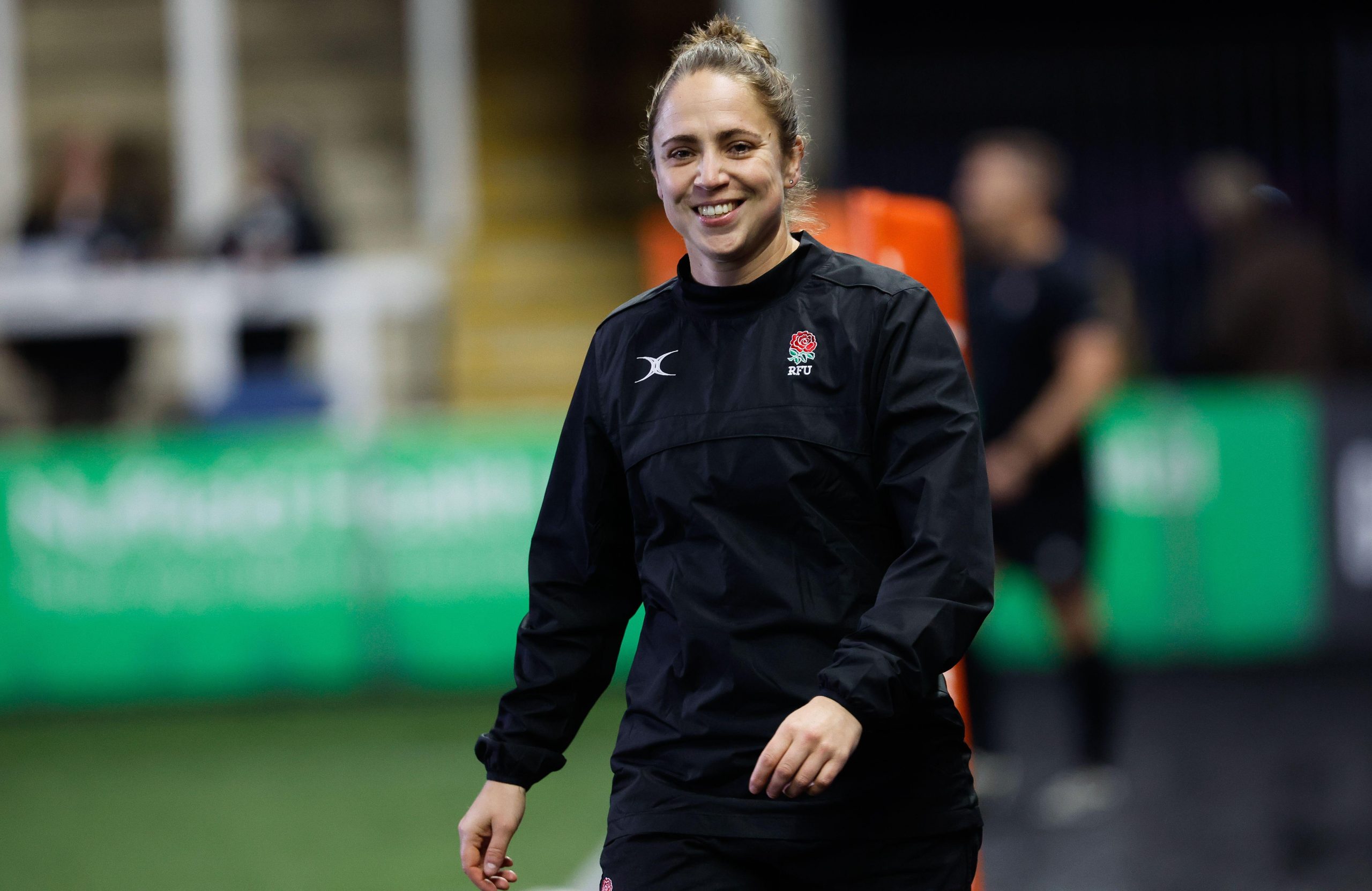
As one of the UK’s most recognisable rugby sports speakers, Sara Cox has redefined what’s possible in officiating.
From becoming the first woman to referee a men’s Premiership Rugby match to earning global recognition for her trailblazing achievements, Sara has broken barriers at every stage of her career.
In this exclusive interview with The Champions Speakers Agency, she reflects on the challenges of stepping into uncharted territory, the importance of visibility for women in rugby, and why creating inclusive environments off the pitch matters just as much as performance on it.
Q: You’ve made history as a trailblazer in rugby refereeing. What were the defining challenges as you broke new ground in the game?
Sara Cox: “Um, I think as with everything, it’s really difficult when you’re first to do something, because you are the first. So nobody’s trod in that path before.
“It was really good to follow in the footsteps of two others, and two females that had really pushed the boundaries and really started making people ask questions.
“Then I sort of came along and I started to, a little bit, just sort of take on that gauntlet and take that to the next level. I found myself in a position where nobody had ever trodden that before, and nobody had been in that position where a female had been at that level.
“Especially with the players as well, it was a little bit of a new thing for everyone, and we all had to get over the hurdle of: what do we call you? Do we still address you as “Sir” like we would other referees?
“And yeah, I sort of took that over, and I found myself in a position where I was trying to sort of break through those glass ceilings and really, again, push forward and take on that next challenge.
“And yeah, there were things that got in the way. Yes, there was a question around my gender. Is it possible that you can do that? Is it possible for you to get to the next level?
“And we sort of got into a position where “yes” kept being the answer, and all of a sudden I found myself in a position where we were knocking on the door of a Premiership game.
“Then my boss said to me, “It’s time. We’re going to go for it.” And that’s when I found myself in the middle of the Harlequins‘ WORA game.
“And honestly, to be there and know what I’d overcome in the past, what I’d done to get myself there—the fitness, the amount of stuff that I’d done in the background to really get myself in that position—it was all starting to pay off.
“I get there in the middle and it was amazing. It was the best feeling in the world. I had my family around me, and it all really made everything worthwhile.”
Q: Rugby, like many sports, is still male-dominated in certain areas. What’s your message to women trying to carve out a path in that environment?
Sara Cox: “Yeah, that’s a really good question. I guess I put it back to, effectively, dogged relentlessness and just not giving up.
“Male-dominated environments are really difficult. And basically, what they are is male-dominated environments. You’re surrounded by a norm of men being in those positions, and as a female, when you come in and you start challenging that, it does raise some eyebrows.
“It does get some questions. There is some resistance to what’s happening. It’s about effectively not letting that stop you from doing it. You’ve just got to keep going.
“And I’ve had some really low moments, and I’ve had some really high moments as well. You get into a position where you say, “That was worth it in the end,” because people looking in say, “If you hadn’t have done that, my child wouldn’t be paying attention to rugby.
“And my brother or sister wouldn’t want to go off and do this.” It’s not necessarily about my role as a referee. That in itself is quite something—you have to be a certain type of person to want to do that.
“It’s about the focus coming in on rugby, and rugby as a support network and as a community and as a sport that actually people want to get involved in in the background.
“And without that, without the background stuff, I wouldn’t be in the position that I’m in. So we need people supporting that.
“So it’s about being involved, being around that, and just absorbing the atmosphere and enjoying just being in that sport.”
Q: In your experience, what practical steps can clubs and organisations take to build genuinely inclusive environments?
Sara Cox: “I think it’s about understanding what people need, and that can almost be regardless of your gender at that point. It’s about understanding the human beings themselves.
“So take an example: if you were to treat me the same as my male counterparts, it wouldn’t work because I have different needs to what they do.
“So it’s about actually understanding that individual themselves and really sort of tapping into: right, what do you need? How can I make that happen for you?
“How can I put you in the position that your environment is stable, is what you enjoy being in, so that you can perform to the best of your abilities?
“And I think that in itself has really been my mantra as well—what can I do to create an environment where I can thrive? And that’s regardless then of my gender. That’s just about me as a human being.”
Q: Why is female visibility in rugby—whether on the pitch or with the whistle—so important for the sport’s future?
Sara Cox: “I think it’s really important that young athletes see other younger athletes involved. It’s really important that they have someone to admire and something to look up to as well.
“And I think by me putting my face out there, it’s given a platform for people to understand that not only am I slightly younger when I started doing this, so there is clearly a pathway that’s there, I’m also a female that’s managed to do things in a world that hasn’t happened before.
“So I think it’s really important that people have other people to be inspired by. And again, that can be regardless of gender as well. It’s just about putting it out there all the time to say, “You don’t have to be in the latter stages of your career to achieve something.”
“You can be younger. I started back in 2007, so I started when I was 17. So that in itself is a little bit of an unknown, because people take up refereeing probably after playing, after the latter stages, if you like, of rugby.
“Whereas myself and a couple of other people took it up very early on. So it is there. It’s about challenging that norm and starting to challenge to say, “Well actually, no, this is a pathway that now is a career path.”
“And it has really paid dividends for myself, where I’ve gone around the world, I’ve experienced some phenomenal things that I just never would have got an opportunity to do if I hadn’t taken that up.”
This exclusive interview with Sara Cox was conducted by Chris Topmkins of The Motivational Speakers Agency.


International Rugby
Heartbreak for England as Thomas Ramos snatches the Six Nations title for France






The best betting sites
















You must be logged in to post a comment Login