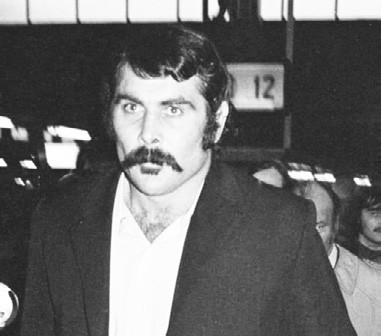


THE fate of Keith Murdoch has always captivated the rugby world but when he died in 2018 many questions were left unanswered.
Firstly a quick bio of the man involved. Murdoch, right, was no spring chicken at 29. Even though he had only played three Tests, he had ten years senior experience behind him with Otago, Hawkes Bay and Auckland and had made his New Zealand debut on their 1970 tour of South Africa. He ‘enjoyed’ a wild man reputation and off the pitch, was immensely strong with, famously, a 48 inch chest of which much mention was always made.
So what happened? Why the enduring infamy? In the early morning of December 3, 12 hours after scoring the winning try over Wales, Murdoch got into a fight in the kitchen at the Angel Hotel in Cardiff with a 29-yearold security officer named Pete Grant who was from Cwmbran.
Grant, pictured the following day with a nasty black eye, says he was called to the kitchen after reports that Murdoch, in search of either food or drink, was kicking off with the staff. A scuffle of sorts clearly ensued with Murdoch at one stage being restrained by members of the New Zealand management and squad members.
There is another, New Zealand version of the story, that insists that Murdoch was acting in response to an attack on another member of the All Blacks tour party in the kitchen. Nothing is definitive and is likely to stay that way.
Initially Murdoch escaped with a severe reprimand from New Zealand manager Ernie Todd and the following evening he was named in their side to play the Midlands West on the Wednesday. By Monday morning however Todd had apparently slept on the matter and decided that Murdoch must be sent home.
The players, who were told the news on the team bus as they left for Birmingham, were disgusted and suspected somebody had “got” to Todd overnight. Could it have been the Four Home Union’s committee or perhaps the RFU?
Murdoch though was already walking on thin ice. As reported on these pages Murdoch had caused a major scene in the hotel after the All Blacks lost to the North West counties – which wasn’t reported at the time – while journalist Norman Harris also alleged an assault on himself by Murdoch at the New Zealand hotel in Peebles when the Kiwis were in Scotland.
Was external pressure brought to bear? Again nothing has been definitely established in the interim but it’s worth emphasising that security was paramount during this period when “The Troubles” were raging and everybody concerned with the tour party’s security was on edge. The last thing you needed was a loose cannon and the unpredictable Murdoch had the capacity to make everybody very nervous.

What happened next is also a little murky. We know that en route to Auckland he got off in Singapore and diverted to Darwin and then went bush, disappearing into the outback and leading a nomadic lifestyle for the next 45 years. Over the years there were reports of him working as a deckhand on a tuna fishing boat, as a sheep farming roustabout, as a truck driver and as an oil rigger in Western Australia.
In 1990 he was definitely living in Tully in Queensland because TV journalist Margot McRae tracked him down, left, and although he spoke with her he refused to oblige with a filmed interview. McRae later turned that experience into a play entitled Finding Murdoch.
By 2002 he was at Tennant Creek, north of Alice Springs in the Northern Territory. We know that because at one stage in 2002 he was called to give evidence in the case of a young Aborigine man – Christopher Limerick – who had been found dead at a disused mine nearby. The Aborigine had twice broken into Murdoch’s small bungalow in the previous two months, chased off by the former All Black. The coroner concluded Limerick had died of exposure and dehydration. No charges were brought against Murdoch.
He died in the remote Western Australia port of Carnarvon in 2018, just weeks before being due to see his son for the first time. Murdoch had reportedly fathered the child just before he flew to Britain in 1972 and had only become aware of his existence in the months prior to his death when they had started to correspond regularly.
Gone but not forgotten. Until his death an empty chair was always left for him at All Black reunions while members of New Zealand sides in Cardiff still traditionally look into The Angel to raise a glass in his memory.