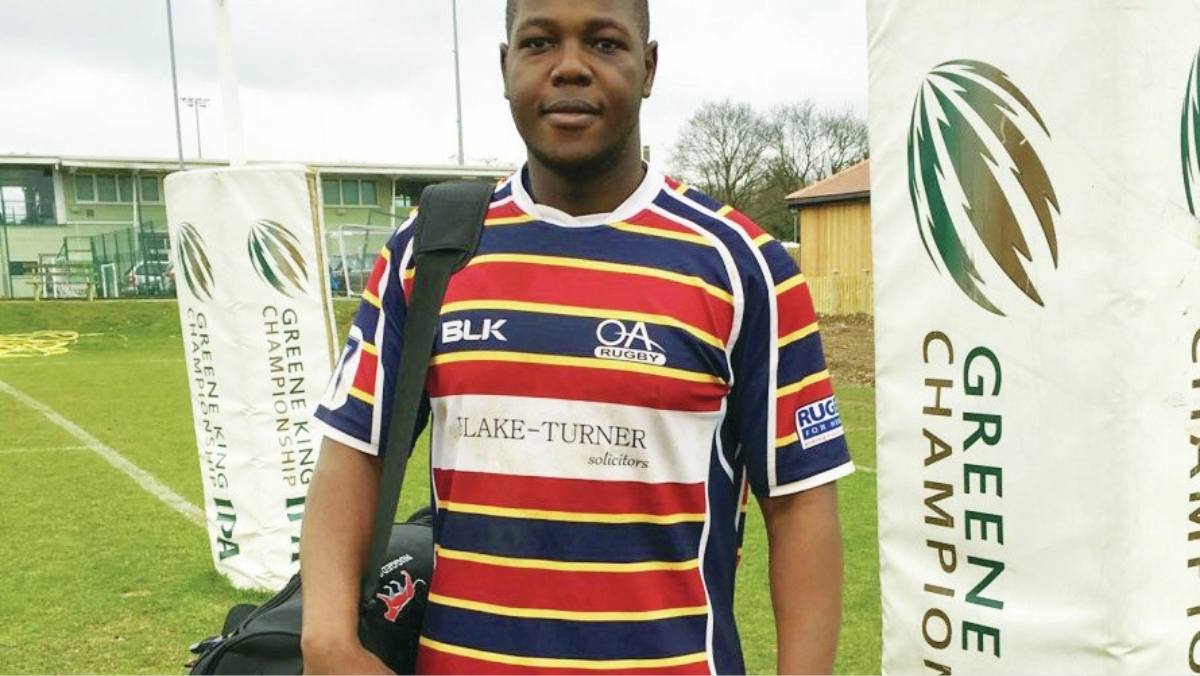


The proudest moment of my rugby career wasn’t a try, a win or even a final. It was standing in Harare, pulling on the Zimbabwe shirt, singing the national anthem and looking up to see the president’s helicopter circling above the stadium.
You’ve got fans packed in, noise everywhere, and then that moment of silence before kick-off where it all hits you.
That’s when you realise rugby is bigger than just the game.
It’s about family, identity and representing something far beyond yourself.
Hooked
I actually started my life in Zimbabwe in a very sporting household, but rugby wasn’t the main focus early on.
My dad was a professional footballer – a goalkeeper – so sport was always in the blood. My mum worked within football as well, so naturally, I grew up around that environment.
I did everything as a kid – athletics, swimming, hockey – but rugby wasn’t really on my radar at first. In fact, I actively avoided it. Like most people, I thought I’d just get injured.
It wasn’t until I was around the equivalent of year three or year four that a teacher suggested I give it a go.
I wasn’t convinced, but I tried it anyway – and in my first game I scored two tries. After that, one of the parents gave me a little reward – a sticker book – and that was it. I was hooked.
Skill development
When I moved to the UK, rugby began to take a more serious role. I was at St Peter’s in Gloucester, where the head of rugby was also linked with Gloucester Rugby, and that’s where I really started to understand the game properly.
The focus on skill development, structure and game awareness was completely different. I also played for a local club called Longlevens, which helped me settle into rugby in England.
But it was when my family moved to Liverpool that things really stepped up.
At Sefton Rugby Club, I properly ingrained myself in the game and began to develop.
From there, I progressed through Merseyside and then Lancashire at county level. That period was important, but also frustrating.
Reality
Liverpool rugby can be quite traditional and, despite performing well and leading in my position statistically, I missed out on a few opportunities.
Instead of waiting around, I decided to take things into my own hands and reached out to Sale Sharks.
They asked for clips, I sent them over, and I was offered a place in the academy.
At that point, everything changed overnight. You feel like you’ve made it, like your rugby career is finally taking off. Then reality hits very quickly.
Not long after joining, I suffered a serious injury – I broke my fibula clean through. It was one of those moments where everything stops.
You go from thinking your future is sorted to suddenly being told that when you come back, you won’t be the same player.
I was a winger at the time and the style of play required speed – something you lose after that type of injury.
The club were honest with me. They had other players in the same position who were just as good, and they needed pace.
So I was released. It’s harsh, but that’s professional sport.
University route
After that, I went down the university route at the University of Chester. I still played a bit of rugby with Chester Rugby Club, but that period was more about resetting and figuring things out.
I had to completely rethink my game.
I’d grown up idolising Bryan Habana – his pace, power and explosiveness – but I knew I couldn’t play like that anymore.
So I adapted. I moved from the wing into the centres and started modelling my game on Manu Tuilagi.
It was about physicality, carrying hard and finding a different way to impact games. That shift changed everything for me.
After university, I stepped away from rugby for a short period before picking it back up again properly.
I joined Old Albanian during a strong spell for the club in National One, and from there, I stayed involved in the game while balancing work life as well.
Then Zimbabwe came calling. At that point, they were rebuilding and looking for players who understood the game and could bring something to both sevens and 15s. For me, it wasn’t even a question.
Challenges
Playing international rugby as part of a Tier 2 nation comes with its challenges.
There are financial issues – I remember waiting around ten months to be paid at one point – but you don’t do it for the money. You do it for pride, family and your country.
We had some incredible moments during that time, including winning the Rugby Africa Championship, which was huge for Zimbabwe.
But there were also frustrations – particularly against Namibia, who were always the benchmark. We came close, but just fell short, and that’s been the story for a while.
Injuries eventually caught up with me. I’ve got arthritis in my left knee now, no meniscus and serious ligament damage, so playing consistently just isn’t possible anymore.
You might dip in now and again to help out, but your body won’t do what it used to.
That’s when coaching became the next chapter. It really started during my time at Rams, where I began doing my coaching badges and even refereeing qualifications.
Grow
I realised quite quickly that I loved it – especially the defensive side of the game. Defence wins matches, that’s always been my mindset.
Now I’m working in sevens, including with Poland, where the goal is clear – win Rugby Europe and qualify for the Olympics.
It’s ambitious, but it’s achievable with the right structure and development. What I enjoy most is helping players grow.
Taking someone from a starting point and developing them into a top-level performer is incredibly rewarding.
There are players in that Poland setup who I genuinely believe can reach the very top of the game.
READ MORE: My Life in Rugby: Cai Griffiths – Downing Australia was just incredible