
The first time I realised professional rugby wasn’t always as serious as it looked was on a Scarlets pre-season trip to Slovenia.
We were supposed to play Treviso, but the fixture got cancelled. Gareth Jenkins, who appreciated life both on and off the pitch, told us we’d earned a night out after three brutal training days.
The “night” turned into three. It felt less like pre-season and more like a stag do with lineouts.
For a young front rower in his first professional environment, it was eye-opening – and a reminder that rugby teams are built as much on laughter and chaos as they are on drills and weights.
Nerve
Then there was the time we tried to psyche out a teenage Luke Pearce when he refereed us at Birmingham.
He pulled the six front rowers aside for a chat and we all stood millimetres from his face to test his nerve.
He never blinked. I remember walking away thinking, “Fair play, that kid will go far.” And he has.
Moments like helping Bordeaux win promotion to the Top 14 in front of 30,000 fans, are the snapshots that define my career.
They say props mature late and they’re right. The best rugby of my life came after 28, which isn’t bad for someone who didn’t even start playing properly until I was 16.
Grounding
I grew up in Swansea and went to a school better known for football than rugby.
My headmaster, John Guy, kept insisting I give rugby a go – probably because my build was changing faster than my sprint times.
I finally relented and joined my local club, Waunarlwydd, at 16. Within three years, I’d gone from a novice to winning a Wales Youth cap in 1999, which still feels surreal even now.
At that stage, if you wanted to progress, you had to play senior rugby in the Welsh Premiership.
Dunvant were based in Swansea, where I was studying at university, so it made sense to join them. They were a proper club side – hard men, no-frills, and full of local pride.
But game time was limited, so I moved west to Whitland, where a young Mike Phillips was an emerging scrum-half.
It was a brilliant grounding. There were no academies or fancy pathways back then; you just got thrown into senior rugby and learned the hard way.
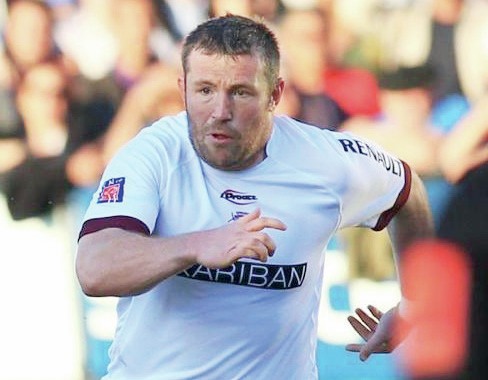
Loving life: Ricky Davies in action for Bordeaux
Took off
Carmarthen Quins came next, and that’s where my career really took off. The Quins were a Scarlets feeder club, and when Gareth Jenkins came calling, I jumped at the chance.
Signing for the Scarlets was my introduction to professional rugby – suddenly I was training with internationals I’d grown up watching.
I didn’t play as much as I wanted, but the experience was priceless. It taught me what proper preparation and professionalism looked like.
After a couple of seasons, I knew I needed a fresh start, so I took a leap and headed to Italy to join L’Aquila.
One year there, one huge education. The rugby was physical, the food was incredible, and the people were passionate beyond belief.
You’d walk through the town on a Friday and see flags in the windows. It made me realise how deeply rugby can root itself in a community.
Massimo Cottita the legendary scrum coach was part of the coaching set up alongside Darren Coleman (recent Waratahs coach) and this transformed my scrum technique.
Exhilarating
When I returned to the UK, Russell Earnshaw convinced me to sign for Birmingham & Solihull.
It turned out to be one of the best moves I ever made. Russ wanted us to play a 15-man version of sevens – high-tempo, fast-handling, all-action stuff – and for a front rower it was exhilarating.
We won National One and reached the Championship, and I was playing the most enjoyable rugby of my life.
I’d agreed to join Worcester mid-season but asked if I could play one last derby for Birmingham against Moseley before the paperwork went through.
I ended up injuring my back in that very game. Six weeks on the sidelines and the move fell through. That’s rugby. For every door that opens, another one slams shut.
But fate had something else in mind. My agent called about a short-term deal in France. Bordeaux-Bègles needed a prop for the final four months of the season.
I went for it – and never left. Everything clicked straight away: the city, the rugby, the lifestyle. We won promotion to the Top 14 and suddenly I was scrummaging in packed stadiums against world-class opposition.
I stayed in Bordeaux for the rest of my playing career, finishing with three seasons in Fédérale One before finally hanging up the boots in 2016, aged 36.
Proud
Those years in France were the best of my rugby life. The atmosphere, the passion, the way entire towns live for their team – it’s incredible.
The Top 14, for me, is the best domestic league in the world. To have been a small part of that story is something I’ll always cherish.
When I retired, I wasn’t ready to step away from the game completely. I started refereeing partly to stay fit, partly because I was curious to see rugby from the other side.
I ended up refereeing for six years, even taking charge of a couple of finals at the Principality Stadium, which was a proud moment. It’s one of the hardest jobs in sport.
Players have no idea how much pressure referees are under until they do it themselves. You’re trying to make hundreds of split-second calls while 30 blokes and 300 fans scream at you.
I tried to use my playing background, to let the game flow and apply common sense, but apparently that’s not what assessors always want!
Still, it gave me huge respect for the officials who operate at the top level today.
Explosive
The game’s changed a lot since I was packing down every Saturday. When they replaced the big “hit” with crouch-bind-set around 2014, it transformed scrummaging.
I’d made a career out of being explosive across the gap, winning the collision. Suddenly, that part of the game disappeared.
It made scrums safer in theory, but I’m not sure rugby is safer overall. Rucks, for instance, are now a war zone – bodies flying in at ankle height, players jackalling in dangerous positions.
When I started, the ruck was self-policing. You didn’t put your head where it didn’t belong, or you’d quickly learn not to.
The players today are physical freaks – bigger, faster, stronger than ever.
When I watch Premiership or Top 14 matches now, the pace is unreal. You had to be tough in my era; now you need to be tough and superhumanly fit.
Old passion
After retiring fully, I went back to another old passion – travel and events. While still playing, I’d led supporter tours for Gulliver’s Sports Travel, mixing rugby stories, songs and a few pints along the way.
I loved it. So when the time came, I set up my own sports-travel business. I sold out of my previous company in 2023, got married, and my wife, who’s a doctor, and I took a year off to travel the world.
I’m currently launching two new ventures: Eventful Cities focused on hosting sports events and immersive experiences, and Sportivacation a new sports travel brand offering bespoke supporter trips, youth and team travel and corporate rugby experiences – with Top 14 as our flagship offering.
Having lived in France for eight years, I know the culture inside out in Bordeaux – its wine, rugby, food, and sunshine make it a standout destination.
And alongside that, we’re working with some of the finest clubs in the Top 14, each offering its own exceptional local experience that we’re excited to bring to life.
Grateful
The Welsh regions are crying out for identity and connection. You only have to look at France to see what’s possible.
Their clubs are local institutions; families go every week, players are household names, and success breeds support. Rugby in Wales used to be the same.
It can be again, but it’ll take bravery and vision from those in charge.
When I look back now, I just feel grateful. I was a late starter who somehow ended up playing in Italy and France, winning leagues, refereeing finals and making a living from the sport I love. Rugby gave me everything.
If you ever bump into me on one of Sportivacation’s Top 14 weekends maybe in Bordeaux, I’ll be the bloke with a glass of red, watching the scrums and muttering about how they used to do it properly – because once you’ve been in the front row, you never really leave it behind.
– as told to Ben Jaycock
READ MORE: My Life in Rugby: Bobby Knox – I loved being a Cov kid playing there for so long



The best betting sites