
My Life in Rugby with Tom Williams – The former Harlequins & Esher winger/full-back looks back on his life in the game
WHEN I look back and reflect on certain decisions that I made in my rugby career, I cannot help but think that the fact I grew up in environments where you were told what to do and when to do it moulded me. Institutionalised is too strong a word but boarding schools and professional rugby clubs are very pre-scripted environments, where there is very little scope to go outside of any lane, so I was in a position where I always wanted to please and seek approval.
Yes, I was afforded opportunities most people don’t get and was very fortunate to go to a school like Wellington, after my dad trained to become a pilot and got a job in Hong Kong with Cathay Pacific. Part of that process was the decision to send me to boarding school, aged nine and, unsurprisingly, being 8,000 miles away from my family made me homesick. I made the best of friends while I was there, friends for life, but there were some residential effects that led to me responding to authority in a certain way. If you put an incentive in front of a request, like you are going to get paid more if we win, then there is no surprise that the outcome will potentially lead to some nefarious behaviour.
In my case, that was the cut lip and Bloodgate. I think back and wonder why as a 25-year-old guy I made a decision to run onto a field and accept the blood capsule handed to me by Steph Brennan, thinking this is a fine piece of behaviour. It is easy on reflection and think what a stupid decision, which it was, but when you factor in all the factors around decision-making it is easy to see why the decision was made. It would have taken a stronger character than I was to have said, no way, to Mark Evans, Dean (Richards), and Steph. But I wasn’t equipped from a maturity perspective and morality perspective to do that.
People ask do you regret it but regret is a bit of a waste of time, it has happened, it is done. I wish I had done things differently; I wish I hadn’t pushed the doctor into cutting my lip. But I did it and I have got to live with it and I have got to help my children grow up in an environment where they can hold their own and are empowered to make their own decisions, or ask a third-party if they are not sure.
Did Bloodgate change me as a player? I was oblivious to many things before Bloodgate. I was living on talent and arrogance after my privileged upbringing. I got a contract with Harlequins the day after I left school and was then involved in a relatively successful environment, where I thought I was living the dream. After Bloodgate, I was petrified of making a mistake and being in the public eye but also wanted to be known for something other than a stupid period of my career. When I was going through my options during the fall-out, and the one-year ban, I thought, ‘what else am I going to do’? And also, ‘how do you want to be remembered’?
“After my privileged upbringing, I was living on talent and arrogance”
I made a massive mistake and I could either run away, leave the sport and become a barrow boy in the City, or whatever, or show everyone that I have learnt from the mistake, become more mature, and try and be known as Tom Williams, the rugby player, not Tom Williams, bloodgate scandal. I think I succeeded to an extent but when I retired the headline in The Times was ‘Bloodgate player retires’. My actual name was only mentioned in the fifth line. You don’t always win in life! In an ideal world, I’d liked it to have said ‘Tom Williams, Harlequins winger, played in 215 games, represented England at 7s, scored in a Premiership Final, got voted Players’ Player of the Year in 2013′ … that would have been lovely. But as Joe Lycett would say, ‘that doth butter no parsnips”.

On my first day at Quins in 2002, Dan Luger was there, Jason Leonard was there, Keith Wood was there, Will Greenwood was there, Nick Greenstock was there … they were all hanging around. For me, that was as much a golden a generation as you could get – there were certainly more established inter nationals in that team than we had when we ended up winning the Premiership 10 years later in 2012.
Collin Osborne was my academy manager and pretty much coached me the whole of my career, so he was a really big influence and being around the likes of Tony Diprose and Luke Sheriff and Simon Miall, who were two years above me, was great. Mark Evans oversaw everything, and was doing a fantastic job off the field but on the field we were scraping by. As a club, we thought we were too big to go down and we were trying to change and bend the rules of the Premiership in order to stop it ever happening. It was arrogance of the highest order and something needed to happen. Dean came in when we ended up in the Championship. He had a legacy of success, had this pugnacious style and rumbustious behaviour and it really changed the focus of the group. It was ruthless, it was uncomfortable, it was entertaining, and it was divisive in many ways. Sometimes you hated Dean and sometimes you loved Dean, and sometimes it led to be a big division in the squad. What was united about it was everyone was keen to impress in order to try and play and we got success.
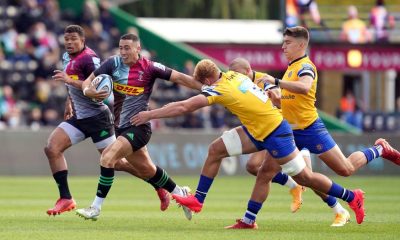
After Bloodgate, Conor (O’Shea) came in and really refined how we wanted to be identified and how we should play to get success. That was putting a lot of faith in youth but also by having core inter national players who were hugely influential, such as Maurice Fa’asavalu. He was brilliantly physical on the pitch and led behaviours off it. As outside backs, we had a lot of fun because of the hard work of those around us, such as Jordan Tur ner-Hall busting holes through the middle. I don’t think we realised the potential of the group at that time, we were just caught up in having a good time and were all aligned in how we approached the game. We worked hard and wanted to entertain and, for me, that’s the Quins DNA.
Once my playing days at Quins were over, I went into coaching in the academy for three years while also having a lot of fun playing in the National Leagues with Esher. Transitioning into coaching straight away was eye-opening in many ways. You have to be pretty well-rounded as a person and I think I was just a bit too early in that jour ney for it to be a success. I soon realised it was people, not rugby, that I enjoyed coaching so, after 16-17 years at the club, I stepped away and set up my own consultancy business. That didn’t work out but a recruitment company ran by Tom May, FutureProof Pro, put me in touch with a digital agency called Skylark. The company builds websites and apps and I feel like I have really fallen on my feet. I have the opportunity to share all my lear nings, from a spectrum of experience, in order to find refinements and efficiencies in everything we do.
While I hardly ever watch rugby anymore – I am too busy watching my kids play sport – I do coach at Guilford, alongside Chris Cracknell, who I would now say is one of my best friends. We aspire to bring a higher purpose to our coaching.
The community game is struggling and we want to create an environment that is welcoming, one where people want to spend time down at the club and not think rugby is just one, long stag do. Whereas professional rugby is the Zenith, the community game should all be about participation and enjoyment. I’d like to think that’s one of the things we’ve got right.
– as told to Jon Newcombe