MY LIFEIN RUGBY
THE FORMER WORCESTER AND HARLEQUINS SECOND ROW TURNED NFL PLAYER
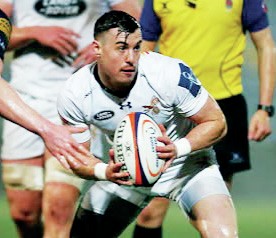
SIGNING my first professional rugby contract in the changing room on the evening of my 1st XV debut for Worcester set the stage for an incredible adventure for me which saw me play two sports professionally at the highest level.
I will always be grateful to Dean Ryan because he saw my potential when I was in my third year at Loughborough Uni, as a fourthchoice lock in the National One team. I’d never been in an academy, never played any county rugby or anything like that, so was pretty raw. I always had ambitions to play at a highest level because my dad was a boxer – he won the ABA Super Heavyweight Championships in 1985 and once fought Frank Bruno and is now VC of the British Boxing Board of Control – and my brother played basketball at college in America. The thought that I hadn’t done anything, especially given my physical attributes, was always hanging over me, and I thought my dream of making it big in rugby was over until Dean invited me down to play in an A-League game five weeks before handing me my debut in a cup game against Leicester.
There was someone who was already contracted, full-time in the academy, and was training day in day out and waiting in the wings, and here I was, just five weeks in, not even knowing all the lineout calls, getting in the team ahead of him so that was an interesting thing to navigate. But the nature of the beast in professional sport is you’ve got to perform. Dean wasn’t afraid to upset the applecart and I was determined to pay back his faith in me, so it was nice to score on my debut.
Just when things were gathering pace I was faced with one of the greatest challenges in my life. I had to find a way to overcome the improbable and return to professional sport after breaking two bones in my back. Through that process of self-recovery, I really hit rock bottom because I could hardly walk – and all the anxiety around that, together with all the stuff that was going on at the club. There were a lot of doubts about whether I would even play again but I had great people around me that helped me through some of the most challenging days of my life and early career.
I had to learn how to walk and run again. I could barely do a single push up after the surgery. I had to completely rebuild my body and my mind.
In hindsight, breaking my back was the best thing that ever happened to me. It gave me the opportunity to go back to school and get a Masters degree. It allowed me to find the purpose in my pain. It gave me the mental tools to deal with adversity that I never could have anticipated. It taught me humility, patience and diligence. I had to have a lot of patience – there were exactly 726 days between the last game before I broke my back and the first game back – my Premiership debut in the London double header.
Solomons. By the time it got to Alan Solomons, I was banging down the door making team of the week off the bench, making highlight reel plays – including a big hit against Wasps that went viral. I went in every week asking what I had to do to play and the goal posts kept moving. I was told we like Donnacha (O’Callaghan) and Will Spencer is playing really well so you’re just going to have to sit there.
In the four years I was at Worcester, I had several coaches. It went Dean Ryan, Carl Hogg/Nick Johnston, and then Gary Gold and Alan
“Racial slurs were used by one senior figure. It was completely toxic”
It was my belief that I had come back from injury an improved player, so those reasons just didn’t sit well with me. Added to that I wasn’t happy with the environment. I was getting overlooked and wasn’t valued. Every day was a struggle. All the boys were saying what’s going on here? My experience at Worcester is actually what drove me to be on the RFU‘s independent inclusion and diversity panel and was part of the reason I became a barrister, to fight injustice.
Categorically, black players and Pacific Islander players were treated completely differently to white players. You can look at how the tone of recruitment changed – who was left, who was rewarded big contracts. Some of the contracts going to players who were just sucking up to the coaches. At some points, racial slurs were used with impunity around the place by one senior figure. It was completely toxic. It amounted to harassment and bullying. The players got on with each other, but the environment was too chaotic and badly run.
I was 23 or 24 at the time, really about to enter the prime of my career, so it was a big decision to leave Worcester. I wanted to play for England and wanted international honours. I knew I was more than capable, but it just came down to opportunity. That frustration was part of the reason why I was willing to jump at leaving.
I saw America and American Football as more of a meritocracy and with my physical traits I’d be more valued than in rugby. So I joined Pittsburgh Steelers. Part of the reason I wanted to leave rugby is because my face didn’t fit, so it was inspiring to be coached by a black coach at Pittsburgh in Mike Tomlin. He said if you’re good enough, you’ll play. I was terrible in the first year, I didn’t know anything. The analogy I use is that it was like turning up for trial with Man Utd without having ever kicked a ball. I was going up against T.J. Watt for three years, he won defensive player of the year and signed a 100 million dollar contract, so I had to accelerate my learning, and fast. By the second year coach Tomlin said I’d given myself a legitimate shot at making the team. They basically all-but started me in the first pre-season game and I tore my hamstring in the first play. Then in my third year over there, Covid happened. I had nerve damage and it hit its peak, and the day before training camp I was medically waived. I ended up having six surgeries and the nerve damage is now permanent because the surgery I had in America was done in the wrong place and made things worse. It was tough, especially as my dad was on a ventilator from Covid while I was out there and I was in the worst pain imaginable.
I flew home from America in November 2020. Mentally and physically I was in a pretty bad way. I couldn’t walk 600m for almost a year and was suffering from depression because of it all. I’m not a drinker so I didn’t drink myself silly but I comfort ate – chocolate, and lots of it, to the extent that my weight ballooned to 140kg. I’m down to 123kgs now, but it’s been a threeyear process getting my body back together, including two further operations. During that time, I started my law conversion, just so that I had something tangible to take from that period when I could barely leave the house.
Mike Lancaster was head of sports medicine at Worcester and a constant ally of mine, so when he persuaded me that I could get back playing again, I trusted his judgement. By now, he was at Quins and I accepted a one-year deal. The club were fantastic, the complete opposite to what I’d encountered at Worcester, and restored my faith in everything. When I’d just finished my law conversion I tore my pec off the bone and I saw that as a sign from god that perhaps my priorities now lay elsewhere, especially as my dad’s kidneys had been wiped out by Covid and he had been on dialysis for a year. I was still putting in good performances but I didn’t have the same hunger for it and just churning out Premiership games wasn’t enough for me anymore. I never said I was retiring, just that I wasn’t playing anymore.
When I was called to the bar in July, it was the proudest day of my life. More so than anything I’d done on the pitch because of everything that had gone in from my family and me. The three pieces of paper I have hanging on the wall, the jerseys and the memories, no one can take that away from me. My message whenever I speak to guys who want to be athletes is to be realistic. I’ve had nine major surgeries, had an eightand-a-half-year career and have just turned 30. For most people once you stop playing there is no money coming in. The transition out of sport takes three to five years to get back on your feet and figure out what you want to do. My message is do it early, do it well, and maximise every opportunity. As far as timing goes, I’d rather go two years too early than two years too late.
– as told to Jon Newcombe