

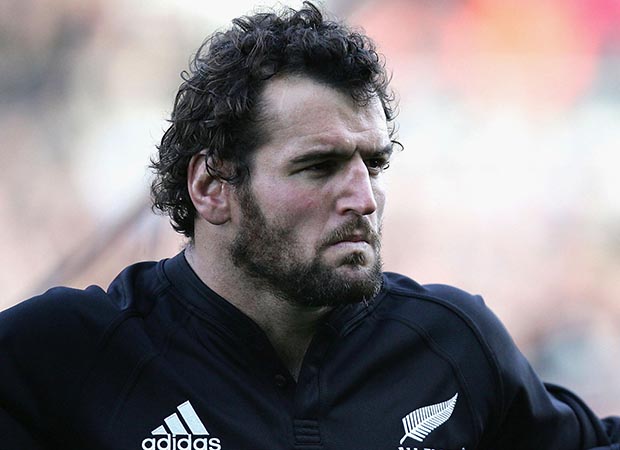
Carl Hayman says rugby is in denial about player welfare and insists there must be improved education on head injuries.
The former New Zealand prop, who won 46 caps before retiring in 2015, is suffering from early onset dementia and probable chronic traumatic encephalopathy.
Hayman is calling for a restructuring of the calendar to lessen the load on players whose bodies are unable to handle the relentless workloads.
“We’ve got to get out of this denial of what’s been happening,” Hayman told The Rugby Paper. “Around head injuries, education is a real big thing and some acceptance by the players would be good.
“Let’s look at the calendar and decide what’s a sensible amount of matches. Do we need bigger squads? Do we need to cut things out that don’t need to be there? Give guys a proper break. International players are on this 10 month treadmill and for some of them it’s even longer than that.
“Players shouldn’t have to ask around for support, if they are having issues cognitively they should have direct access to people that can help them.
“With the reluctance from the governing bodies to accept there’s an issue, there’s a dependence on a public health system which depending on what country you come from can be a difficult process to go through.
“Rugby has a duty of care to the players to provide support and it doesn’t have to be a huge amount, just enough so that if they are struggling they can adjust their lives appropriately and still function to the best of their ability.”
In an attempt to reduce concussions and protect players, the third tier and below in England is operating with a tackle height of below the sternum but Hayman says that’s not the solution.
He added: “The hip is the hardest part of the body. If you get smacked from the hip or knee on your head in a tackle it’s just as bad. It’s at least something that they are looking at these initiatives but my fear is the professional game has changed massively with these rule changes.

“Foul play needs to be punished and direct contact to the head must be sanctioned and dealt with accordingly with suspensions.
“There’s a lot of upright tackling, so there’s a small margin of error. We need to find ways to make it safe but the tackle height as it stands is completely fine, I just think we need to get better at managing the calendar and we can look to help players in that regard as opposed to what’s happening on the field.
“Bad tackle technique can lead to knocks to the head as well, so just lowering the tackle height is not the solution.”
New Zealand headed into Friday night’s clash with South Africa on a run of 11 Tests unbeaten. Former Newcastle prop Hayman was taken back by the early announcement that head coach Ian Foster’s contract would not be renewed after the World Cup, with Scott Robertson taking over. But Hayman believes is has lifted the pressure off Foster’s shoulders and benefited the All Blacks at just the right time.
He said: “I think it was really sad how that was all handled. I know coaching is sometimes a very cruel world but I think the way that was played out in public wasn’t great for New Zealand Rugby. But now he’s got nothing to lose, he’s going out regardless and as a coach it takes some of the pressure off. Often pressure in those environments can have an effect on the players and the coaching group, so Ian Foster has now got no pressure on him at all.
“Since that announce came out we’ve seen an All Blacks team that has put some good performances together. There’s not much between the top teams, so it’s really wide open. France on home soil look threatening; I finished my career when a lot of the current French team were coming through from the U20s World Cup team. It’s going to be a fascinating World Cup.”
England’s World Cup preparations have been derailed due to poor performances under Steve Borthwick and the suspensions of Owen Farrell and Billy Vunipola.
But with England being on the favourable side of the draw, Hayman expects them to compete at the later stages in the tournament.
He said: “England have a great group of players and the great thing about the World Cup is teams can gel and things can change over the course of the tournament.
“France lost to Tonga in the New Zealand 2011 tournament but went on to make the final and probably deserved to win it. England lost to South Africa heavily in their opening game in 2007 and came back to play South Africa in the final. Once the tournament starts everyone clears their slate.
“Getting to the semi-finals you’ve then got two one off games. A lot can happy in rugby and in that position you’re two games away from being a World Cup winner. That helps them immensely, so I think they’re in with a strong chance of doing really well.”
Head On: Rugby, Dementia, and the Hidden Cost of Success by Carl Hayman is published by HarperCollins NZ on 28th September, £16.99


Features
OSCAR WILSON


BUCS Super Rugby
Cardiff Met’s Gus Patterson on becoming Bridgend’s next rugby star


The best betting sites





















You must be logged in to post a comment Login