Connect with us

Autumn Internationals

Paul Rees: France must be northern stars in the Nations Championship

France have emerged as the leading northern hemisphere challengers after the opening phase of the Nations Championship, but Paul Rees believes they must finally prove they can topple world champions South Africa.

It is tight at the top of the northern group in the with two points separating the leading four sides and everything to play for in the second leg.

Wales and Italy are in the not unfamiliar position of jockeying to avoid the wooden spoon.

lead Ireland by one after an impressive first three weeks when they travelled without a number of leading players, including Antoine Dupont, Louis Bielle-Biarrey and Charles Ollivon.

Strong second-half displays saw off and having secured two bonus points in a 34-32 defeat to .

France building for a heavyweight showdown

‘s head coach Rassie Erasmus wants four contenders in each position and France seem intent on the same.

It is all set for the encounter between France and the Springboks in Paris in November, a Friday the 13th that will be unlucky for one of them.

France have won just one of their last 10 Tests against South Africa, 30-26 in Marseille four years ago when South Africa let their lead slip in the final minutes when they were down to 13 and Thomas Ramos finished them off with a penalty.

South Africa played that match with a numerical disadvantage for 34 minutes, Pieter-Steph Du Toit’s early dismissal followed in the second half by Dupont’s red card but they shrugged off Lood de Jager’s dismissal just before the break last year, when they were losing, to score 19 unanswered points in the second period.

It will be a significant night for France whose World Cup quarter-final defeat to South Africa in Paris still rankles.

There will be more than the Nations Championship at stake ahead of Australia next year.

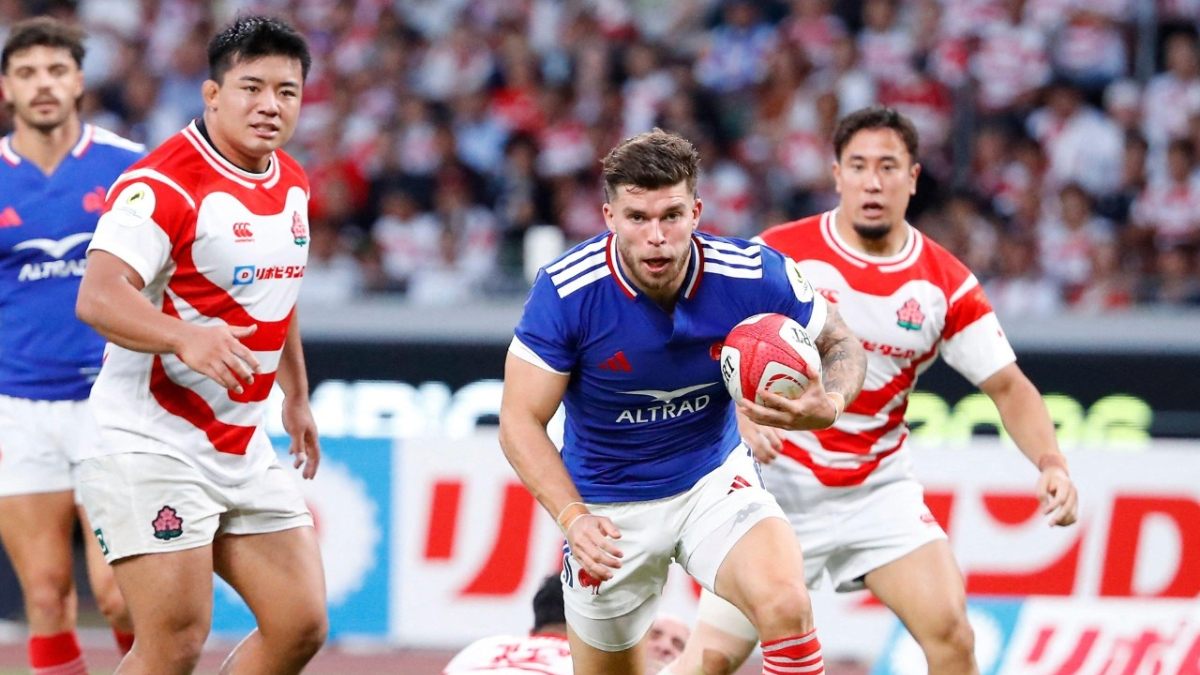
This image has an empty alt attribute; its file name is Matthieu-Jalibert-France-1024x576.jpg

France fly-half Matthieu Jalibert attacks against Japan during the Nations Championship.
PICTURE: Alamy

and eye autumn statement

Scotland are one point behind France, victories over Argentina and Fiji supplemented by a try bonus point in Pretoria when they took the game to South Africa and were only edged out late on.

They face New Zealand first up in the autumn.

Win that and they can start to dream with Australia and Japan to follow, although they have learned in the last decade not to get ahead of themselves.

Whatever, they have a game suited to the modern era.

England are third and have the same set of fixtures as Scotland.

It is a while since a clash with New Zealand at Twickenham had something tangible on it, and if Steve Borthwick did not use this month to assess his depth having come under fire, his side has not lost the bloody-mindedness of the last World Cup.

Northern challenge gathers momentum

Ireland are set in a similar mould.

Age and the evolution of the game has caught up with them, but in Dublin with the crowd behind them they still take some toppling.

Events later in the summer when the Springboks and All Blacks play a four-Test series may prove otherwise, but it looks better to be facing New Zealand in November than South Africa, which gives Scotland and England an edge.

Overall, it was a good first round for the north, eight victories and eight defeats.

The strength in the south is South Africa and New Zealand. Three of the others defeated only Italy or Wales and the sixth, Fiji, failed to pick up a point.

There is a better spread in the north with four teams in contention. France look a cut above, but they need to remember how to beat the World Cup holders.

Here’s how each of the sides shaped up over the opening phase of the Nations Championship.

France

France are the one team that can match South Africa in terms of depth. It amounts to more than numbers because, like the Springboks, they can bring in players and not suffer a drop in performance.

They sit at the top of the northern table after victories over Australia and Japan and two losing bonus points against New Zealand in Christchurch in a 34-32 defeat. They kicked less and moved the ball more.

Only three players in that starting line-up took the field against England at the end of the Six Nations less than four months before with some rested and those who played in the final between Toulouse and Montpellier not considered.

Head coach Fabien Galthie made six changes for the trip to Brisbane where a powerful second half display took them home and in Tokyo on the final weekend, half the pack, including the entire front row, was different.

France prepared for the Tokyo heat by turning off the air conditioning in their hotel rooms and Galthie, not someone who is easily impressed, returned home satisfied.

“The energy of the players at the end of a long season was magnificent and so was the commitment,” he said.

“We changed the front row after Australia because we were not completely satisfied with the scrum, the first and foremost job of a prop.”

Five players made their Test debuts including wing Aaron Grandidier-Nkanang, who was born and brought up in Bromley and went to college in Twickenham, and Damian Penaud made a try-scoring return against the All Blacks.

The clash of the autumn promises to be France’s tussle with South Africa in Paris on a Friday night. Depth is one thing, but France have to deliver.

 
Sharp thinking: Damian Penaud scoring against New Zealand
PICTURES: Getty Images

Scotland

A second half comeback against Fiji in the final round left Scotland second behind France ahead of the autumn schedule.

Head coach Gregor Townsend, above, had made 14 changes from the side that pushed South

Africa all the way in Pretoria but it was his strong bench that made the difference after Fiji led 17-7 at half-time.

“It shows that we have good depth,” said Townsend. “Knowing we have players on the bench who can make a difference is reassuring and we faced a Fiji side who beat us last year and played their best rugby of the campaign.”

Only England scored more tries than Scotland among the European sides, 19 compared with 16 having played the same three fixtures, but

Townsend’s men are ahead of them in the table because of the try bonus point they collected from the Springboks.

Scotland, having shredded Argentina’s defence, showed how to attack South Africa, using Sione Tuipulotu to storm the gainline, and they kicked smartly.

The game was in the balance until the end and swung when Kyle Steyn failed to hold on to a diagonal.

A try and conversion would have drawn Scotland level with a couple of minutes to play, but they missed out on a draw and a second bonus point when the Boks went over at the end.

“It was a long tour at the end of a long season but the players responded really well and there was evidence for them that they can find ways to win,” said Townsend.

Finn Russell only played one match with Tom Jordan and Fergus Burke given starts at 10 and it is perhaps a measure of Scotland’s development that Duhan van der Merwe has a bit-part role.

Scotland open up in November with New Zealand – a first win over the All Blacks would set them up.

Charge: Sione Tuipulotu takes on the Springboks

England

This image has an empty alt attribute; its file name is image-444.png

It is normally as difficult to get a rise out of Steve Borthwick, above, as it is to persuade Donald Trump to take a vow of silence.

But after England’s victory over Argentina, achieved after the TMO’s intervention in the final minute and despite four yellow cards, the head coach let rip when asked about the recurring theme of his team’s indiscipline.

“This team has done wonderfully well in a tough Test (against Argentina) and scored some good tries and, as ever, you guys concentrate on the negativity,” he said.

“You are my negativity committee and it is lovely to be speaking to you again.”

Borthwick, clearly relieved after Argentina were denied the chance of a conversion to draw the match by the TMO, said it was not the right time to talk about discipline.

“Leave that to the review you guys love so much,” he said, but it was exactly the time because England had, in the first half and at the start of the third quarter, done more than enough to win, hanging on at the end after again making poor decisions under pressure.

Borthwick kept team changes to two, one of which was enforced.

Four players made their debuts from the bench, but he decided that with so many players not on the trip and the likes of Courtney Lawes and Joe Marchant available again, he did not need another look at players with a handful of caps.

England appeared to have settled on a style that has tended to succeed in World Cups, strong set-pieces and kicking game.

It nearly got them to the final in 2023 but in attack they rely on Fin Smith’s kicks to the wing, which are admittedly effective.

If South Africa, France and New Zealand swing in stereo, for England it is life in mono.

Their passing remains clunky but they kept Immanuel Feyi-Waboso fit and the Exeter wing showed again he is capable of picking the stiffest lock.

Borthwick’s reaction was seen by some as evidence of tensions in the camp over the gameplan, but at the halfway stage England are well placed even if they may need three wins in November when New Zealand will pay a visit.

This image has an empty alt attribute; its file name is image-445-1024x681.pngKey man: Immanuel Feyi-Waboso breaks through against Argentina

Ireland

It was a month in which Ireland did no more than was expected of them, sneaking victory at the end against Australia and pulling away from Japan late on.

While Scotland and England spent much of the month in the air as they shuttled between South Africa, Argentina and the UK, Ireland’s first two matches were in Australia and the third in New Zealand.

Ireland had injury issues, but their overriding quality was a determination to keep going.

In their final game against New Zealand, they were 28-7down at half-time but fought back through their driving maul and pickand-gos near the line.

What was lacking was individual quality, a player who could make something happen. Ireland were resilient but functional and they struggled moving the ball across the line.

“Our game is not flowing for many different reasons,” said head coach Andy Farrell, above.

“Sometimes it is penalties and others uncharacteristic poor passing, whether into touch or the hands of an opponent.

“We stuck at it and kept fighting.”

Ireland will need that spirit against South Africa in the autumn, a game they will probably need to win with France two points ahead of them and Argentina and Fiji to play.

“I think we are closer to New Zealand than the scoreline showed, but the only thing that matters is how both teams keep on improving over the next 15 months,” said Farrell.

Do Ireland need an infusion of new blood or a new direction in attack?

Teams seemed to have worked them out and the outside-half issue remains with Sam Prendergast, below, starting against Australia and New Zealand.

“It is the end of the season and time for us to reassess,” said Farrell. “We have to learn lessons, otherwise what is the tour for?

“It has been a fantastic experience: the World Cup is in the southern hemisphere and we have to make sure we adapt and do things better.”

Wales

Miracles do happen, but not to the point of Wales topping the northern group next autumn.

They beat Fiji, which was far from a given, before becoming Argentina’s only victims and again failing to score against South Africa.

It is nearly three years since Wales defeated one of the other foundation unions with their three victories under Steve Tandy coming against Japan, Italy and Fiji.

It is where Wales are, improving slowly but lacking in too many areas to trouble the leading sides.

At least Italy had a worse month and the men in red should avoid the ignominy of finishing bottom.

There is a doggedness about Wales, epitomised by Dewi Lake, Jac Morgan and Alex Mann, but their flair player is a prop, Rhys Carre, with Louis Rees-Zammit starved of possession and even dropped for one match.

Wales in all three matches went for a ball-playing 12 to get their attack flowing, but what they needed was a physical presence there.

They did not try Eddie James there, or the uncapped Bryn Bradley, and outside-centre Max Llewellyn only received one pass against South Africa before being taken off.

Given their shortcom-ings, it was surprising Wales were not more reactive.

They dogged it out against South Africa, but in a one-sided contest it was about keeping the score down which, in a sense, they did having conceded 73 in Cardiff last November.

“I think we are, or at least I hope we are,” said Morgan, when asked if he thought Wales were closing the gap to the top sides.

“You can see the progress we have made since the autumn. The squad has developed.”

Wales ended a long losing streak, for sure, but their test in the autumn will come against Australia, who are lagging some way behind New Zealand and South Africa.

It is about small steps for Wales who are the hardest team to watch of the Six Nations sides because they are offering little other than determination and character. Rome was not built in a day and all that.

Working hard: Dewi Lake on the charge for Wales

Italy

With Fiji, the Azzurri were the big disappointments of the first leg. It seems an age since they defeated England for the first time last March.

Unlike Ireland, who had the same three opponents, Italy were not spared a demanding travel schedule, from Japan to New Zealand and then a 10-hour flight to Perth because of stopovers.

Head coach Gonzalo Quesada was critical of that, as he was about the refereeing of Luc Ramos in the clash against New Zealand which earned him a two-match ban from all match day activity, which included being in the stadium in Australia.

“I think the refereeing team was partly to blame for the score,” said Quesada after the New Zealand defeat.

“They made a lot of mistakes today. That said, I think the All Blacks absolutely deserved the win – they played an extraordinary game.”

A two-match ban? Really? It would have been a bold move on Rassie Erasmus, but Italy drink from a different pool and for all the improvements they have made in the last couple of seasons, this was a journey too far.

The big blow was in Tokyo where, despite taking an early lead, Italy faded and did not score in the second half as Japan secured a 17-point win.

Their final match against Australia pitted them against a team also looking for a first victory. The outcome was a one-sided affair that the Wallabies won 57-10.

“We can consider various factors, but the only answers we can find are within ourselves, “said Italy’s captain, Michele Lamaro, below.

“It only takes one time for us to fall slightly short of our standards, especially in terms of physicality, and we pay for that.

“After being in this group for a few years, I’ve realised that it’s not that difficult for us to bounce back after negative periods. Pride always helps us come up with a response.”

READ MORE: Paul Rees: Southern giants lay down an early Nations Championship marker

Click to comment
 

Tackle the News

- Sign Up for our weekly Rugby Newsletter
Your subscription could not be saved. Please try again.
Your subscription has been successful.

The Rugby Paper

The best betting sites

Globusbet

BetpackUK casinos on Slotozilla

the best minimum deposit £5 casinos casinobonusesfinder

Full list of UK betting sites at BookiesBonuses.com kasyna akceptujące paypal

MAN-v-FAT-Rugby

free bets

online bookmakerFull list of UK betting sites at BookiesBonuses.com

GGBetBanner Depicting Therealefl.co.uk an affiliate site for Licensed UKGC Football bookmakers.

More in Autumn Internationals