It is a common sense deduction that the 25 players awarded £150,000 annual EPS central contracts recently are England coach Steve Borthwick’s chosen men for the 2027 World Cup.
Ideally, with a year-long runway to the tournament, it should be a statement of bristling intent.
Each of the names should resonate loudly with England supporters – with at least half a dozen of them knocking loudly on the door of a World XV.
However, such is the state of Borthwick’s team after a fifth place finish in the 2026 Six Nations, followed by a summer battering by South Africa, that there are none in contention.
Decline
Where there was Jonny Wilkinson, Martin Johnson, Jason Robinson, Lawrence Dallaglio, Will Greenwood, Phil Vickery, and Ben Cohen in the 2003 England world champion side, they now have no one considered to be the best in the world in their position –including Maro Itoje.
South African locks Eben Etzebeth, Ruan Nortje, and rehabilitating RG Snyman, have edged the resting Red Rose captain out of contention.
Given the rise of all-action Wallaby lock Josh Canham, whose parents are English, and the promising All Black Fabian Holland, the path back for Itoje is steep.
Recalling the excellence of the 2003 team might sometimes seem like a stuck record, but it remains the surest measure of where standards were, and how far they have fallen.
A big part of that decline is the outright inconsistency of the players in the squads that Borthwick has assembled since he was appointed head coach in December 2022.
Selection policy
It has been accompanied by similar inconsistency in the head coach’s selection policy over the last four years, demonstrated in particular by the chopping and changing at fly-half, in midfield, the back row, and the back three.
It has also been mirrored by a disruptive churn of coaching staff.
And it could be argued that one of the few factors that has been consistent – as it was with Eddie Jones, Borthwick’s mentor, and predecessor – is that once senior players become embedded in the team they seem to be there in perpetuity.
This is reflected in over a third of the Elite Player Squad announced in August, nine out of 25, being over 30 by the start of the World Cup.
It includes two decorated hookers, Jamie George, the Saracens England centurion who will be 36 when the tournament gets under way, and Sale Sharks‘ Luke Cowan-Dickie, who will be 34.
Both veterans had slowed down significantly due to the march of time last season, and, despite George’s lineout throwing still being Test standard, and Cowan-Dickie recovering from a run of neck/shoulder injuries, the renewal of their central contracts does not add up.
Hard to justify
The most dynamic, consistent hooker in the Prem in recent seasons has been Northampton Saints’ Curtis Langdon.
Having been on the England fringes since winning his first cap under Jones in 2021, the rugged Langdon helped Saints to a Prem title in 2024 before finally being picked for England’s tour of Argentina and the USA in 2025, scoring a debut try against the Americans.
However, after a shoulder injury last season, Langdon fell off the radar and was not selected for the first England training squad of the new season.
Jamie Blamire is another powerful in-form hooker whose face doesn’t quite fit despite an impressive first season with Leicester after joining them from Newcastle.
Blamire has played seven times for England since 2021, but both he and Langdon were bumped from England’s early training plans by George’s erratic Saracens understudy Theo Dan, and Bath’s inexperienced Kepu Tuipulotu, 22, whose throwing last campaign was more miss than hit.
On merit, the selection picture at hooker is hard for Borthwick to justify.

Surprising
Given the season to forget that Sale had, combined with England’s Six Nations stinker, it is also surprising to see central contracts awarded to young prop Asher Opoku-Fordjour, openside Tom Curry, and evergreen fly-half George Ford.
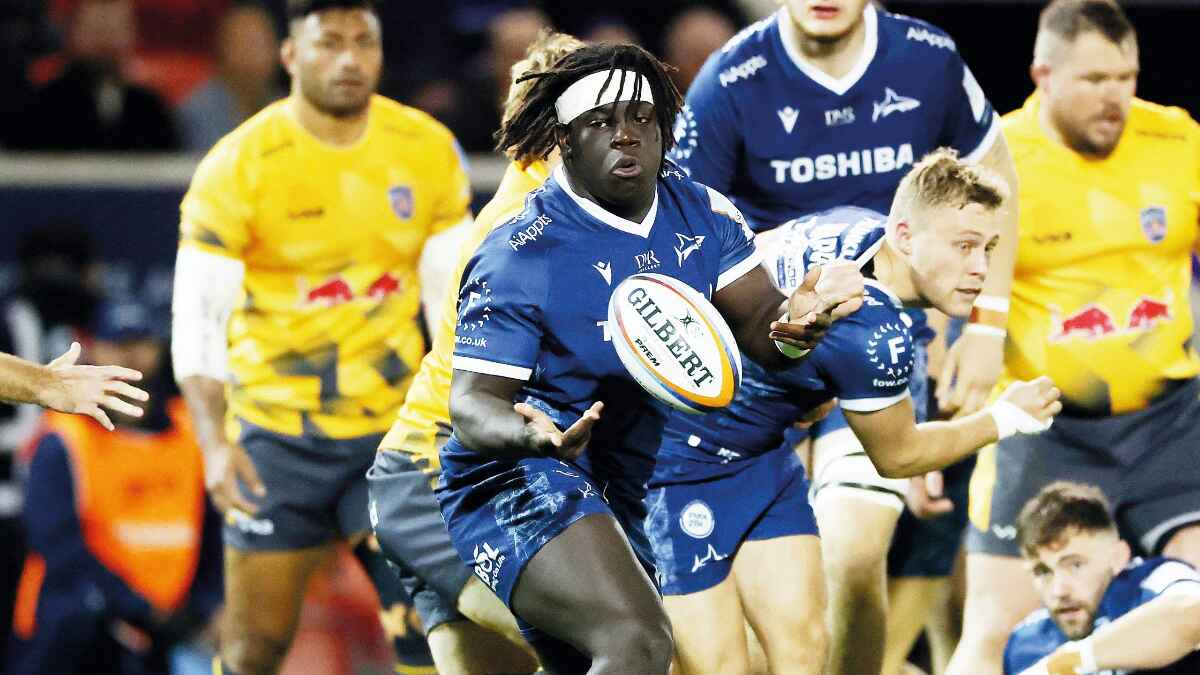
The jury is well and truly out on the Sale project of turning Opoku-Fordjour, the outstanding young loosehead in the 2024 World Rugby U20 Championship, into a Test-quality tighthead.
The 22-year-old appears to be in a no man’s land of switching positions, caught between being a jobbing tighthead and an out-of-practice loosehead.
Although Opoku-Fordjour has put on weight he remains a good, dynamic footballer.
However, it must be in his best interests that he is a master of one trade first – and he was miles ahead of the field at No.1.
 Three of a kind: Asher Opoku-Fordjour and, above, George Ford, below, and Tom Curry
Shadow
There is no escaping that last season Tom Curry was a shadow of the flanker who blitzed the Wallabies in the first two Tests of the 2025 Lions tour.
There were indicators that it was due to issues with his reconstructed hip, but in a pro sport admiration for Curry’s grit and determination to play in the World Cup cannot stand in the way of England building a team to win the tournament.
Where there should be no room for manoeuvre is that Henry Pollock’s days as a bench sub are over.
He should start at No.7 for England this season because his pace and ball winning impact demands it.
The case for centurion fly-half Ford remaining on a central contract does not look particularly convincing when you consider the way that England crumpled in the Six Nations against Scotland and Ireland.
Despite Ford’s huge international experience he was stumped by the way both teams defused England’s kicking strategy.
In the absence of another Prem fly-half coming through to challenge the two Smiths, Fin and Marcus, Ford could offer an insurance policy at 10 during the World Cup – but a central contract seems over the top.
Wide of the mark
Where England are noticeably light in the contracted roster is in the back three, with Immanuel Feyi-Waboso and George Furbank the only beneficiaries.
Consider the impact that South Africa’s back three, featuring pocket rocket wingers Kurt-Lee Arendse and Cheslin Kolbe, plus big bustling Ethan Hooker, and imperious fullback Damien Willemse, had in their 3-1 series victory over New Zealand, and it’s a glaring oversight.
Why, when England’s aerial game requires urgent attention, was there no contract for a tall high ball unit like Tom Roebuck or Freddie Steward?
The premium on having blisteringly quick finishers lurking with intent is also highlighted by South Africa’s use of Kolbe, New Zealand’s deployment of Will Jordan, and the way France launch Louis Bielle-Biarrey.
The importance of quick linking to speedsters like these to race clear and put away chances from deflections, tip-ons, or bobbles of the ball is crystal clear – yet, England’s head coach has completely ignored Henry Arundell, the fastest man in the Prem.
If the essence of central contracts is to improve England’s competitiveness, far too many of Borthwick’s choices are wide of the mark.
READ MORE: Nick Cain: England need all their best players available



The best betting sites