

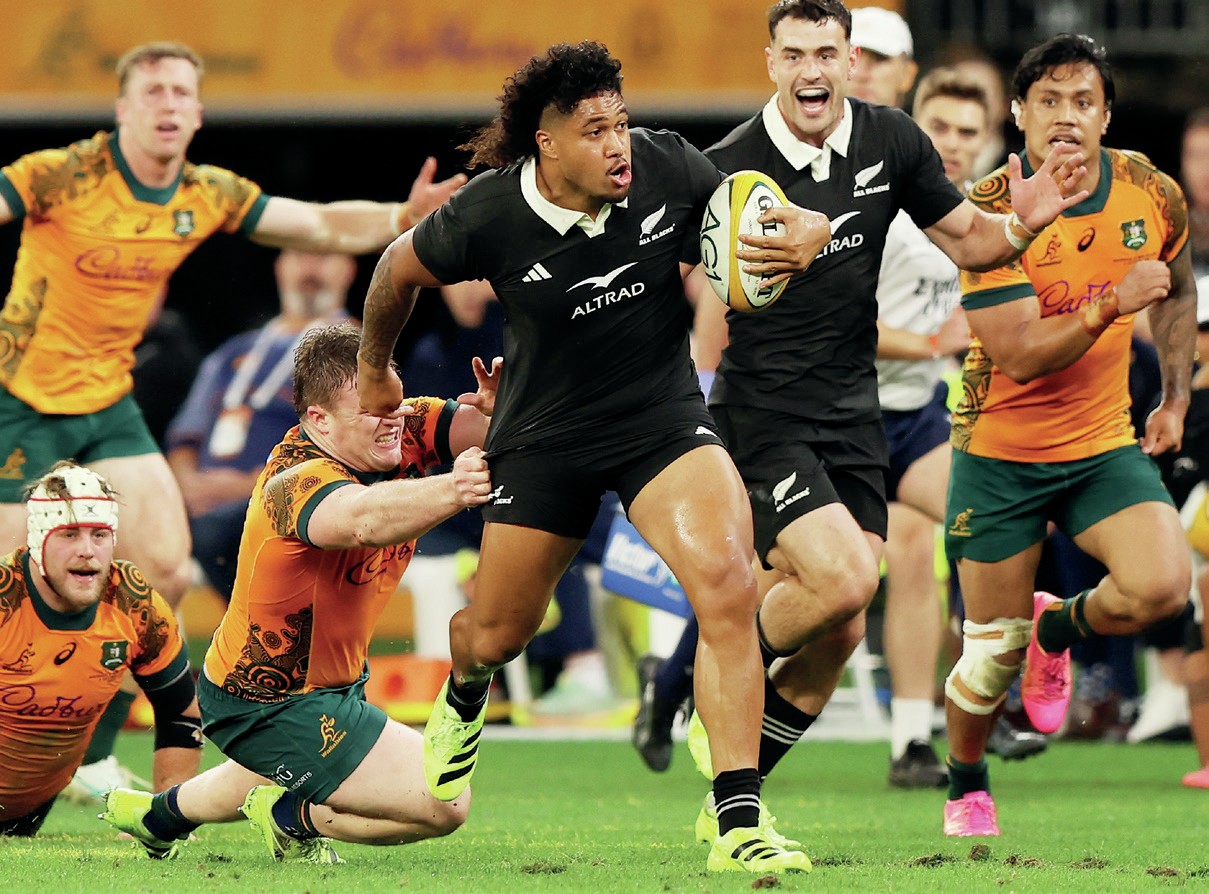
Leicester Fainga’anuku has spent the last few weeks pulling reactions out of rugby fans that the position-purist part of the sport doesn’t usually allow.
A centre and wing by trade, he’s been turning out at openside flanker — winning turnovers, putting in the kind of physical defensive shift that openside is supposed to demand, looking, in stretches, like he was always meant to play there.
The praise has come quickly, and so have the comparisons.
Levani Botia. Kwagga Smith. The deeper memory of Zinzan Brooke and Michael Jones, of Eric Rush as a flanker for Auckland and a wing for the All Blacks.
Each one a benchmark Fainga’anuku is being measured against before his own version of the case has fully made itself.
The pattern is familiar. A player draws notice in a position he wasn’t selected to play. The praise builds. The benchmarks follow.
And the gap between looks great in a club shirt and carries it onto the international stage is the thing every hybrid eventually has to bridge.
What “hybrid” actually means in modern rugby
The term gets used loosely.
In its strict sense, a hybrid is a player whose physical and technical profile genuinely supports multiple positions on the field at top level — not a player whose club happened to move him around because of injuries or squad gaps.
The clearest current benchmark is Fiji’s Levani Botia, who has spent his Test career oscillating between inside centre and flanker without losing edge in either role.
Botia hits like a forward, runs like a back, and reads contact zones the way most number 8s read mauls.
When the word hybrid gets used at top level, Botia is usually what it means.
The 2015 Rugby World Cup is the era cited as the modern proving ground.
Fiji’s selection patterns under that period — using players like Botia in roles that crossed traditional positional lines — pushed the rest of the rugby world to take hybrid selection seriously rather than treat it as squad-management improvisation.
South Africa picked up the thread quickly, with Kwagga Smith carrying the same logic from sevens through to the senior Springbok team and back into Super Rugby.
France and the Top 14 have been fertile ground for hybrid experiments for longer than any of these, partly because the league’s structure rewards versatility and partly because the clubs collect international talent from every corner of world rugby.
The argument for Leicester Fainga’anuku
Fainga’anuku’s recent run is the genuine version of the question.
His appearances at openside have produced the profile fans want from a hybrid: aggressive defence, ball-carrying threat, turnover work at the breakdown.
What makes the case more interesting than a typical “moved out of position” story is the sustained level.
This isn’t a single match. It’s a stretch of performances where the second position has held up under pressure rather than collapsing the first time he’s put against a real openside.
The case against, fairly stated, is that club performance is one thing and international rugby is another.
Fainga’anuku’s hybrid work has drawn praise across Super Rugby and Top 14 contexts, but the test for hybrid status — the one Botia and Kwagga Smith have already passed — is whether the multi-position threat survives Test-match intensity, where the speed of decision-making at the breakdown leaves no margin for a player still calibrating what his role is.
Most positional experiments in rugby look fine in club rugby. The international stage is where the question gets answered properly.
Why hybrids are coming back
The longer arc here matters.
Rugby spent roughly two decades — from the late 1990s through the 2010s — moving steadily toward hyper-specialisation.
Coaches recruited and selected for narrower roles. Forwards trained for the specific physical demands of a single position.
Backs were drilled into specialised attacking patterns. The Test-level game became a contest of specialists.
That trend is partially reversing. The current generation of top sides increasingly values players who can credibly cover more than one role on the field, and that’s not a coincidence.
Squad management at Test level rewards versatility because injury cycles are shorter and replacement windows are tighter.
The eight-man bench, once a depth question, is now a tactical question — and a genuine hybrid is worth two specialists in that calculation.
Selection reads, lineup analysis, and previews of sport events by TipsGG and similar match-analysis resources increasingly flag versatility as a selection asset rather than a curiosity, because that’s how the modern game is starting to weigh it.
This is why the conversation around Fainga’anuku, Botia, and Kwagga Smith feels louder than it would have ten years ago.
Rugby isn’t suddenly discovering hybrid players. It’s returning to a logic the sport always rewarded — and that hyper-specialisation only temporarily covered up.
The historical examples weren’t outliers. They were the version of rugby selection that the specialised era hid from view.
The historical context most fans skip
Hybrid selection in rugby has a longer history than the modern conversation usually acknowledges.
Zinzan Brooke played as a number 8 for the All Blacks for most of his career but was technically capable of shifting through the loose forwards or even slotting into the backline if the situation required it.
Michael Jones did the same, slightly earlier and with even more positional range.
Both were products of an era when fewer players were specialised early, but the underlying ability — to read multiple defensive systems, to perform technical work outside the primary role — is the same ability rugby still rewards now.
Eric Rush is the cleanest single example: a flanker for Auckland his entire club career, then a wing for the All Blacks at international level, holding his own in the same stadiums against the same opposition with a different jersey number on his back.
That wasn’t an accident of selection. It was the same instinct that produces modern hybrids, applied to a slightly different game.
Where Fainga’anuku sits
Set against this longer arc, the honest read on Fainga’anuku is somewhere between hype and dismissal.
The current run at flanker has been long enough and consistent enough that it’s not a club-moved utility play.
The hybrid label is the kind of thing rugby gives early and revokes late, and the players who keep it are the ones who pass the same tests Botia has been passing for a decade.
What separates a genuine hybrid from a player whose club moves him around isn’t the number of positions on the team sheet.
It’s whether the second position is a real second position — performed at the same level, with the same threat, against the same calibre of opposition — or whether it’s a backup option that works when the primary version of the player isn’t available.
Fainga’anuku has the profile to clear that bar. For readers following the transfer and selection narratives that drive these stories, the next chapter is the one to watch.
Club rugby can start the argument. Test rugby is still where hybrid reputations become real.






The best betting sites
















You must be logged in to post a comment Login