



Paul Rees looks at the challenges teams face on the road in the Champions Cup and the Challenge Cup plus more ahead of the finals in Bilbao…
France and Ireland, the leading two teams in this year’s Six Nations, provide the finalists for this month’s Champions Cup showpiece in Bilbao as well as the Challenge Cup conclusion in the Spanish capital the night before.
England‘s last two clubs in competitions that before the inclusion of the South African franchises used to be known as Europe, and may as well still be such has been the four’s lack of impact, Bath and Exeter Chiefs, lost with a bit to spare in last weekend’s semi-finals.
Bath went blow-to-blow with the Champions Cup holders Bordeaux-Begles in a venue that was neutral but not the location (it was the same for Toulon against Leinster the day before and is something that should be reviewed because home territory for one of the semi-finalists has assumed a narrower meaning than was originally intended) after Exeter had made a tamer exit against Ulster in Belfast in the Challenge Cup.
With the Dragons losing in Montpellier in the Challenge Cup, four countries were whittled down for the finals to the two who have between them won the last five Six Nations and the last five Champions Cups, although Ireland have not supplied a champion in the latter, just a three-times runner-up in Leinster who have made it to their ninth final.
Irish and French dominance
Ireland have been involved in 14 of the 31 Champions Cup finals, but they have shown rather less interest in the Challenge Cup.
Leinster won the tournament in 2013, defeating Stade Francais at the RDS Arena, but it is the only other time one of the Irish provinces has taken part in a final.
After what Ulster endured last season, finishing 14th in the URC with only Zebre and the Dragons below them and scraping into the last 16 of the Champions Cup where they came up against Bordeaux-Begles for a second time, winning the Challenge Cup would mark salvation, although they are in contention for the league play-offs with their remaining two matches at home, facing their opponents that were the top two in the table going into this weekend’s round of matches, the Stormers and Glasgow Warrirors.
Montpellier have won the Challenge Cup twice, but the side they picked against the Dragons last weekend indicated they were exercised more by the Top 14: they were third at the start of yesterday, although such is the congestion below the leaders Toulouse that a couple of bad results could see a side drop into the bottom half.
The Challenge Cup has always lurked in the shadow of the Champions Cup, to the point of being eclipsed by it.
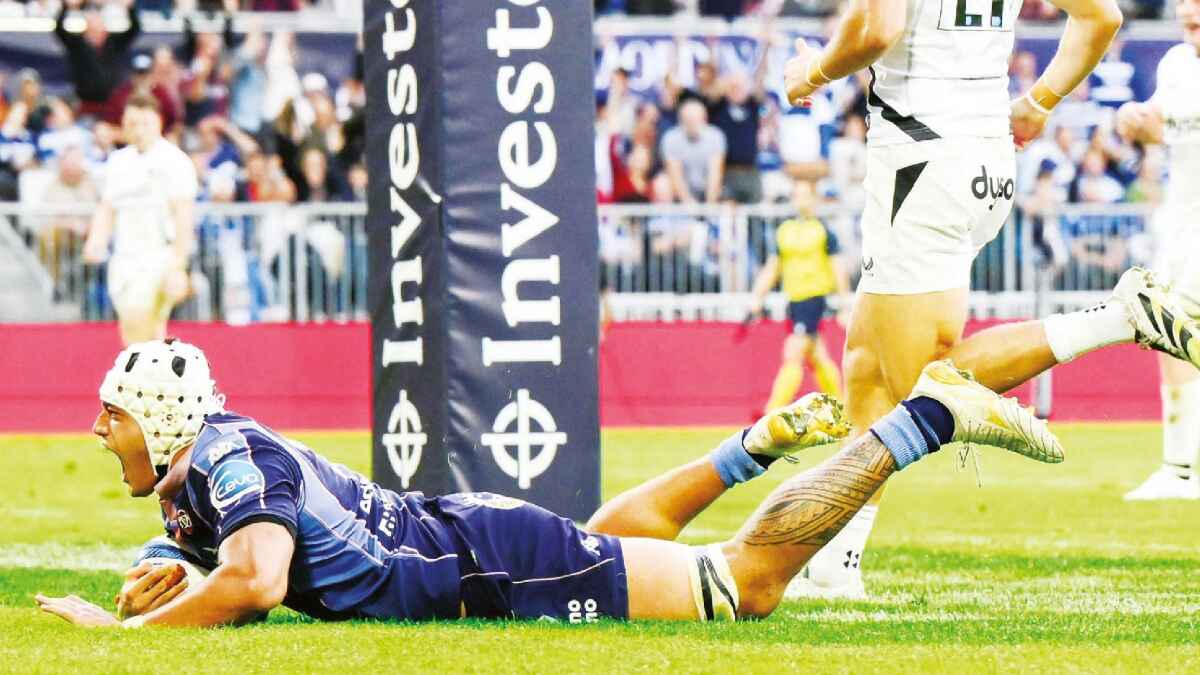
Final push: Temo Matiu scoring for Bordeaux against Bath
PICTURE: Getty Images
Lack of interest for Challenge Cup
The two crowds for the two semi-finals last weekend added up to less than half the number who watched Bordeaux-Begles defeat Bath.
Ulster’s 11,126 against Exeter was their second lowest attendance of the season after the opening league round against the Dragons.
Fewer teams compete in the Challenge Cup than the Champions Cup, 18 compared with 24, although four drop down from the latter at the end of the group stage (none of them made it to the last four this season).
It is not a tournament that many aspire to be in, of no interest to the broadcasters until the final stages and even then not overly so.
Leinster’s director of rugby Leo Cullen, below, remarked after his side hung on to win after Toulon’s late revival last weekend, that the Champions Cup is a formidably difficult tournament to win, as he should know after their run of near misses since last clasping the trophy eight years ago, the other year the final was held in Bilbao.
But it is not formidably difficult to qualify for. Two of Sale Sharks, Gloucester and Harlequins, who have all had seasons to forget, will be in next season’s competition as will half the URC contingent and nearly 60 per cent of the Top 14 clubs.
Idea for a better format
The competition only becomes champion in the knock-out stage proper.
This season, the last eight contained the champions of the three leagues, Leinster, Toulouse and Bath, as well as the URC and Premiership winners of the previous campaign, Glasgow and Northampton Saints, along with the holders Bordeaux-Begles.
Toulon were three-times winners who took the Challenge Cup in 2023 leaving Sale, who beat Harlequins in the last 16, as the outliers and, missing several players, were no match for Leinster.
A better format, in terms of competition throughout, would be 16 teams split into four groups of four with home and away matches followed by the quarter-finals.
The top five in each league would qualify, along with the Challenge Cup holders: if the winners of the Champions Cup did not qualify through league position, they would take the place of the side in fifth.
It would mean an extra week in the season allocated to the two tournaments, the one that was taken away from the Six Nations perhaps, and while there would be fewer teams for broadcasters they would have eight matches for six rounds and fewer blowouts.

PICTURE: Alamy
Beefing up
This year’s group stage saw sides score 40 points or more in 22 matches.
There were 10 losing bonus points picked up in the 48 games, an indication that the gulf in quality was too great for a supposedly elite competition.
The bulk of the sides that conceded 50 points or more in a match were in the bottom half of their leagues: the exceptions were largely down to second teams being fielded, such as the Stormers at Harlequins, leaving Northampton’s 50-28 at Bordeaux-Begles as a stand alone in which two yellow cards told.
Ideally, a team that finish in the bottom half of a league should not qualify for the Champions Cup, or even halfway.
Why not the top five in the Top 14 and the URC going through along with the leading four in the Prem together with the winners of the two tournaments who, if they had already sealed their place, would increase their country’s number.
It would leave 24 teams in the Challenge Cup, six groups of four but no room for Georgia.
It is a tournament that needs beefing up and for many it is their level. Making the Champions Cup should be an aspiration, not something that has a ritual feel to it.
And, anyway, it should be about the taking part, not the qualifying.

Unbeaten
The two finalists are both unbeaten this season.
Bath came as close as anyone to unstitching Bordeaux-Begles, scrambling superbly in defence, while Leinster have become more convincing the longer the tournament has gone on: having chiselled out victories in the group stage, they swatted away Edinburgh and Sale before assembling an 18-point lead against Toulon and holding on.
Leinster are four-times winners of the tournament but have lost their last four finals, three of them narrowly.
Cullen was in charge of them all and took aim at the media after the Toulon victory, saying they wanted to see Ireland’s most successful team in the provincial era fail.
“You would love everyone to get behind the team now,” he said. “When you are up against juggernauts of the game, it is not easy doing it.
“The group will continue to do what they do, it is not always pretty. We are up against some serious teams here. It is insanely hard to win this competition.
“You guys love throwing the boot in when things don’t go well. Whatever sells, you read plenty of it. The courage the players showed, it is a testament. That’s the way it goes.”
Underdogs
Cullen is among the more mild mannered in the high pressure world of professional sport, like Bath’s Johann van Graan.
His side will be underdogs in the final despite having an international starting line-up and a stacked bench.
They have not been as fluent in attack as in the days of Stuart Lancaster and not as watertight in defence as many imagined they would be under Jacques Nienaber – they missed 35 tackles against Toulon – but the holders are the favourites because of their irrepressible nature, able to raise the pace of a game in an instant and armed with match-winners.
Bath pushed them close and may have edged it had their lineout been more productive, one area van Graan is sure to be working on over the summer.
They had an edge in the scrum through Thomas du Toit, below, who was on the field for 73 minutes in what was only his fifth start of the campaign – and his first since January – with his other 13 appearances coming off the bench.
Van Graan’s use of his bench has been a significant factor behind Bath’s rise but they needed du Toit from the start to avoid the ‘home’ side milking the scrum for penalties and kicking for driving mauls.
Just as Bordeaux-Begles had scrambled in defence to keep out Toulouse following a number of line-breaks in the quarter-final, so did Bath who, in terms of possession, passes, carries and kicks exceeded the numbers of their opponents who had to make more than twice as many tackles.

Camera angles
When it came to defenders beaten, off-loads, metres run and line breaks, Bordeaux-Begles scored far higher than Bath and their lineout success rate was 92 per cent compared with 72 per cent.
Van Graan, below, acknowledged that the better team had won but also reflected on how, not for the first time, the perceived failure of the French television director to supply the television match official with every camera angle potentially cost his side.
“For such an amazing contest, we need to make sure that they’ve got the footage they need, and I certainly didn’t see it come through for three clear head-to-head incidents on our No.8 (Alfie Barbeary),” he said.
“The game is in a fantastic place but we have to make sure that we become consistent.
“Certainly, from the footage available to the match officials, who did a fantastic job, it doesn’t seem that way.”
It was not good enough and the director seemed to do their best to make it difficult for the TMO, Ben Whitehouse, to rule that Gaetan Barlot had dropped the ball over the line rather than grounded it: it took an age to reach what with the right angles would have been a quick decision.
Lots to work on
There is so much that is so good about the Champions Cup, but there is a lot that needs to be repaired.
Teams should not enjoy home town advantage in the semi-finals of the Champions Cup: when van Graan experienced his first match at that stage of the competition in 2018 with Munster, Racing 92 travelled from Paris to Bordeaux.
It is beyond belief that Leinster, who play a number of URC matches at the Aviva Stadium as well as Champions Cup group matches, are allowed to play a semi-final on what is their alternate home ground.
Thomond Park may have little more than half the capacity but at least it is neutral territory for both sides and anyway the Toulon semi-final did not produce anywhere near a sell-out crowd.
Bath will be back, and travelling if they enjoy a home country semi-final. They are losing du Toit and Barbeary, but skin grafts are not an issue under van Graan.
Success in the Champions Cup is rarely achieved without the bitter taste of disappointment, although Toulon’s lavishly assembled squad in the 2010s was an exception.
Leicester, Munster, Leinster, Saracens, La Rochelle and Bordeaux-Begles all suffered before reaching the top.
And Bath lost to Northampton in the Premiership final before returning the following year and going one better.
In the last three seasons, Bordeaux-Begles have picked off every club in the top six of the Premiership, some more than once.
Bath were the hardest to subdue and if van Graan will at some point have to think about how to follow two players his bench does not have compatible cover for, Finn Russell and Ben Spencer, it is not quite yet.
Champions Cup final
May 23: Bordeaux Bègles v Leinster 14.45, Bilbao
Challenge Cup final
May 22: Montpellier v Ulster 20.00, Bilbao


READ MORE: Paul Rees: Attacking sides get away with too much at the breakdown